

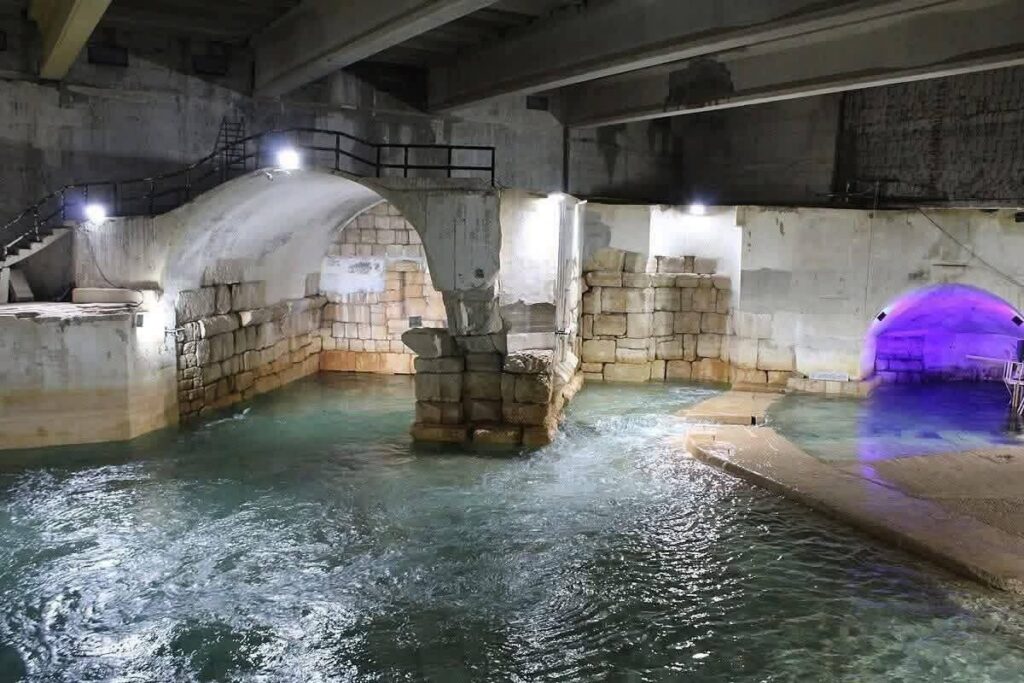
Water in Syria is no longer simply a public-service or humanitarian issue; it has become an element of national security and regional stability amid declining water resources, deteriorating infrastructure, and growing climate pressures. The issue is particularly significant in a region where water basins overlap with political borders, especially in the Golan Heights and the Jordan River basin, where water considerations intersect with the security and economic interests of Syria, Israel, and neighboring countries. Understanding water security therefore requires looking both at people’s needs and at relations among the countries that share the same basins.
Syria: Water Challenges Beyond Drought
International indicators show the scale of the pressures facing Syria’s water sector. In February 2026, UNICEF reported that approximately 14.4 million people, including six million children, urgently needed water, sanitation, and hygiene services.
According to World Bank data released in April 2026, water supplies had declined by about 40% compared with pre-conflict levels, more than half of water-supply infrastructure had been damaged, and approximately 70% of wastewater treatment plants had been affected. Annual water availability per person had also fallen below 700 cubic meters.
This crisis reflects the interaction of several factors, including years of conflict, aging networks, energy shortages, and limited operational capacity, alongside drought, climate change, and reduced flows in some transboundary waterways. In April 2026, the World Bank approved $225 million in grants for the water and health sectors, including $150 million for a water project; these are approved funds and do not mean that rehabilitation work has been completed.
The Golan Heights and Jordan River Basin: Geographic and Strategic Importance
The Golan Heights are strategically important because of their elevated geographic position and their connection to a water system that includes springs, groundwater, tributaries of the Jordan River, and the Sea of Galilee.
Since Israel took control of most of the Syrian Golan in 1967, the area has remained a central issue in Syrian-Israeli relations for reasons involving land, sovereignty, and security, alongside its water and economic significance.
In 1981, the United Nations Security Council, in Resolution 497, declared Israel’s imposition of its laws and administration on the occupied Syrian Golan null and void and without international legal effect. By contrast, the United States recognized Israeli sovereignty over the Golan in 2019. This difference underscores the need to distinguish political positions from the legal status reflected in United Nations resolutions.
The Golan’s hydrological importance is evident in the Banias River, one of the principal tributaries of the Upper Jordan River. The Upper Jordan system is also fed by the Hasbani River from Lebanon and the Dan River. The Yarmouk River, whose basin is shared by Syria and Jordan, is connected to the Lower Jordan River system. Water management in this area is therefore not solely an internal matter for any one country, but is connected to water flows and uses among several parties.
Projects to use water from the Jordan River and its tributaries became a subject of regional disagreement in the 1950s and 1960s, during a period of growing competition over resources needed for agriculture and development. Projects to divert headwaters contributed to tensions at the time, but water was not the sole cause of conflict; issues of sovereignty, borders, and security were also involved.
Advances in desalination and water reuse, particularly in Israel, have changed some aspects of water security compared with earlier decades. Nevertheless, shared natural water sources retain their economic, environmental, and strategic importance.
In this context, Syria regards the Golan as an issue of sovereignty, land, and natural resources, while Israel views the area from security and strategic perspectives, alongside considerations of resources and development.
The Hasbani, Wazzani, and Litani: Water Geography Beyond Borders
The region’s water system extends beyond the Syrian-Israeli border. The Hasbani River originates in Lebanon and helps feed the Jordan River, making the use of its waters a matter of shared regional consideration.
The dispute over a project to pump water from the Wazzani Spring in 2002 illustrated the sensitivity of managing transboundary resources and the importance of technical coordination in avoiding tensions. According to United Nations reports, the dispute raised fears of a military confrontation between Lebanon and Israel before diplomatic efforts involving the United Nations, the United States, and the European Union helped contain it.
The Litani River, which flows entirely within Lebanon, is an important national resource for irrigation and power generation. Although the Litani area has historically been linked to security developments in southern Lebanon, the river is not part of the Jordan River basin, and its hydrological and legal status differs from that of shared rivers. This distinction is important to avoid conflating water-resource geography with the surrounding political disputes.
Water Security and Regional Stability
Syria’s experience shows that water security depends not only on the abundance of natural resources but also on efficient management, the continuity of infrastructure, the ability to adapt to climate change, and political and security stability.
In Syrian-Israeli relations, water is one strategic dimension linked to geography, sovereignty, and development, but it is not an independent explanation for a conflict shaped by broader historical, political, and military considerations.
In 2026, U.S. mediation efforts in Syrian-Israeli security talks resumed in an effort to reduce tensions. Published information does not establish that water sharing was a direct subject of these talks; however, the experience of shared river basins illustrates why data exchange and technical coordination remain important elements in managing regional risks.
Relevance to the U.S. Congress
For the U.S. Congress, the issue connects several regional priorities: stability in Syria and Lebanon, the security interests of neighboring countries, and the effectiveness of U.S. diplomatic efforts. Internationally financed rehabilitation projects also provide an opportunity to monitor spending outcomes, including the reliability and quality of water services and the number of people benefiting, without assuming that the United States directly financed these projects.
The availability of safe water also has added importance in creating conditions for the voluntary and sustainable return of Syrian refugees, alongside security, housing, and employment opportunities. However, improving water supplies does not resolve political conflicts, just as managing shared rivers alone does not guarantee peace. Water security remains one factor in long-term recovery and stability, requiring careful technical analysis that does not reduce regional conflicts to competition over resources.
Prepared by: Antoine Bassmaji