

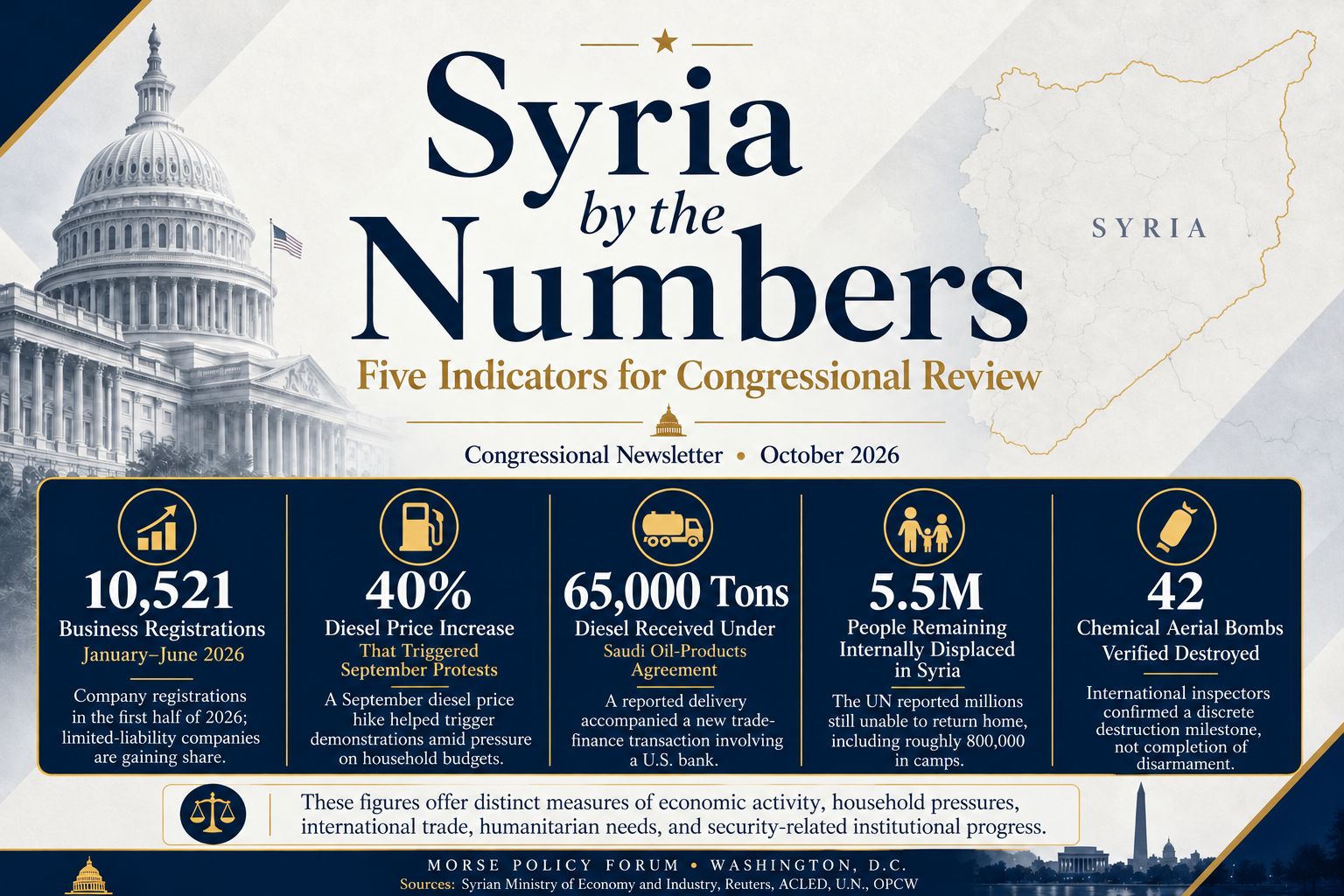
Five indicators capture contrasting developments in Syria’s transition as of October 2026. More than 10,000 businesses were registered in the first half of the year, while a 40% diesel-price increase prompted public protests in September. A new Saudi fuel shipment, supported by trade financing involving a U.S. bank, points to renewed commercial connections. Yet roughly 5.5 million people remain internally displaced, even as international inspectors have verified the destruction of 42 chemical aerial bombs. Together, these figures offer Congress distinct measures of economic activity, household pressures, international trade, humanitarian needs, and security-related institutional progress.
Syria by the Numbers — October 2026
10,521
Business Registrations, January–June 2026
Company registrations in the first half of 2026; limited-liability companies are gaining share.
40%
Diesel Price Increase That Triggered September Protests
A September diesel price hike helped trigger demonstrations amid pressure on household budgets.
65,000 Tons
Diesel Received Under Saudi Oil-Products Agreement
A reported delivery accompanied a new trade-finance transaction involving a U.S. bank.
5.5M
People Remaining Internally Displaced in Syria
The UN reported millions still unable to return home, including roughly 800,000 in camps.
42
Chemical Aerial Bombs Verified Destroyed
International inspectors confirmed a discrete destruction milestone, not completion of disarmament.
These statistics reflect different reporting periods and types of evidence: an administrative count, a one-time price decision, a delivered shipment reported by an official, a humanitarian estimate, and an internationally verified destruction total. They should not be treated as interchangeable measures of progress. Taken together, they show why signs of recovery must be assessed alongside living conditions, displacement, and the implementation of verifiable security commitments.
1. 10,521 Businesses Registered in the First Half of 2026
Number: The Syrian Ministry of Economy and Industry recorded 10,521 business registrations during January–June 2026. Limited-liability companies accounted for approximately 19.8% of new registrations, compared with 5.7% in 2024.
The increase reflects a broader rebound in formal business registration. Annual registrations rose from 8,675 in 2024 to 18,023 in 2025, according to the figures analyzed by economist Karam Shaar. The greater share of limited-liability companies may indicate interest in business structures that permit investors to pool capital while limiting personal exposure.
The first-half figure should not be treated as a final 2026 total. Nor does a registration prove that a business has begun operating, hired employees, obtained financing, or generated sales. Changes in registration procedures can also influence the number of filings.
For congressional review, these data offer an early indicator of private-sector formalization, relevant to commercial engagement, financial access, and the conditions for durable economic recovery. Employment, production, and actual investment remain separate measures.
2. Diesel Prices Rose 40%, Triggering Public Protests
Number: On September 13, 2026, Syrian authorities raised the standard diesel price by approximately 40%, from 125 to 175 Syrian pounds per liter. The change was followed by demonstrations across multiple governorates.
Source: Reuters — September 14 and 17, 2026; ACLED — September 2026.
The demonstrations highlighted the tension between attempts to manage rising fuel-import costs and the purchasing power of Syrian households and businesses. Analysts and reporting linked the increases to international procurement costs, import dependence, and maintenance-related disruption at the Baniyas refinery.
Following the protests, the government introduced differentiated diesel prices, including cheaper categories for some heating, agricultural, and industrial uses. The 40% figure therefore describes the September increase that prompted the protests; it should not be presented as a uniform price increase that necessarily remained in effect for every fuel category afterward.
For congressional review, the episode demonstrates how economic policy, energy availability, and public confidence can interact during a fragile transition. It provides a concrete measure of the pressures that can persist even as commercial and financial ties improve.
Additional context: ACLED analysis and Reuters on revised fuel pricing.
3. Syria Receives Approximately 65,000 Tons of Saudi Diesel
Number: A Syrian Petroleum Company official told Reuters on October 20, 2026 that Syria had received about 65,000 metric tons of diesel under an agreement with Saudi Aramco.
Source: Reuters — October 20, 2026.
The agreement is notable beyond the fuel shipment itself. Reuters reported that J.P. Morgan confirmed a letter of credit issued through Syria’s banking system to support the transaction, marking a step toward renewed access to international trade-finance channels following years of isolation.
The shipment documents a specific supply transaction, not a sustained increase in national production, a long-term guarantee of imports, or a decline in retail fuel prices. Its economic implications will depend on continued access to supplies, reliable payment arrangements, and downstream distribution.
For congressional review, the transaction offers a concrete example of the intersection between U.S.-linked financial services, regional energy trade, and Syria’s economic reintegration. The relevant outcome is whether restored commercial mechanisms support consistent supplies and wider productive activity.
4. Approximately 5.5 Million Syrians Remain Internally Displaced
Number: UN reporting carried into the October 12, 2026 Security Council discussion indicated that about 5.5 million people remained displaced inside Syria, including approximately 800,000 people living in camps.
Source: United Nations, Security Council humanitarian reporting — September 17 and October 12, 2026.
The figures show the scale of unfinished recovery despite returns by refugees and internally displaced people. Many families continue to face damaged housing, weak public services, limited livelihood opportunities, and insecurity that complicate decisions about returning or settling elsewhere.
The approximately 800,000 camp residents are included within the larger displacement total; they must not be added to the 5.5 million. The statistic refers to displacement within Syria and is not a count of Syrian refugees living abroad.
For congressional review, continuing displacement is relevant to humanitarian assistance, the rehabilitation of housing and essential services, and the practical conditions for safe, voluntary, and sustainable returns. Changes in total displacement should be interpreted alongside access to shelter, water, schools, and employment.
October reporting: UN News live Security Council coverage (republished).
5. OPCW Verifies the Destruction of 42 Chemical Aerial Bombs
Number: In August 2026, the Organisation for the Prohibition of Chemical Weapons verified the irreversible destruction of 42 aerial bombs associated with Syria’s chemical-weapons program. The United Nations reported this to the Security Council on September 3.
The verification followed renewed Syrian declarations and cooperation with international inspectors concerning remnants of the former government’s chemical-weapons program. UN officials described it as the first OPCW-verified destruction of Syrian chemical munitions since 2014.
The number is a verified count of munitions destroyed, not an estimate of all remaining materials and not a declaration that every outstanding issue in the chemical-weapons file has been resolved. Further inspections, documentation, and verification remain important.
For congressional review, this development provides an independently verified indicator of progress in nonproliferation and international monitoring. Continued transparency and access for inspectors are essential to assessing the broader disarmament picture.
Policy Relevance
The five indicators reveal progress and friction occurring at the same time. Business registrations suggest greater formal commercial activity, but do not establish job creation or firm survival. The September fuel-price protests show how quickly economic pressures can affect public confidence and daily life.
The delivery of approximately 65,000 tons of diesel and the involvement of a U.S. bank in the transaction are tangible signs of changing commercial and financial channels. They do not, by themselves, demonstrate energy affordability or a broad-based economic recovery.
Meanwhile, the continuing displacement of approximately 5.5 million people highlights the importance of safe housing, basic infrastructure, services, and livelihoods. The OPCW’s verified destruction of 42 aerial bombs represents a measurable nonproliferation milestone, while unresolved verification questions remain.
For congressional review, the statistics offer reference points for assessing commercial engagement, sanctions-related implementation, humanitarian and stabilization efforts, and nonproliferation oversight. Their value lies in distinguishing announced activity from delivered outcomes and in tracking whether improvements become lasting, inclusive, and independently verifiable.
By Morse Policy Forum
SMNN Congressional Newsletter