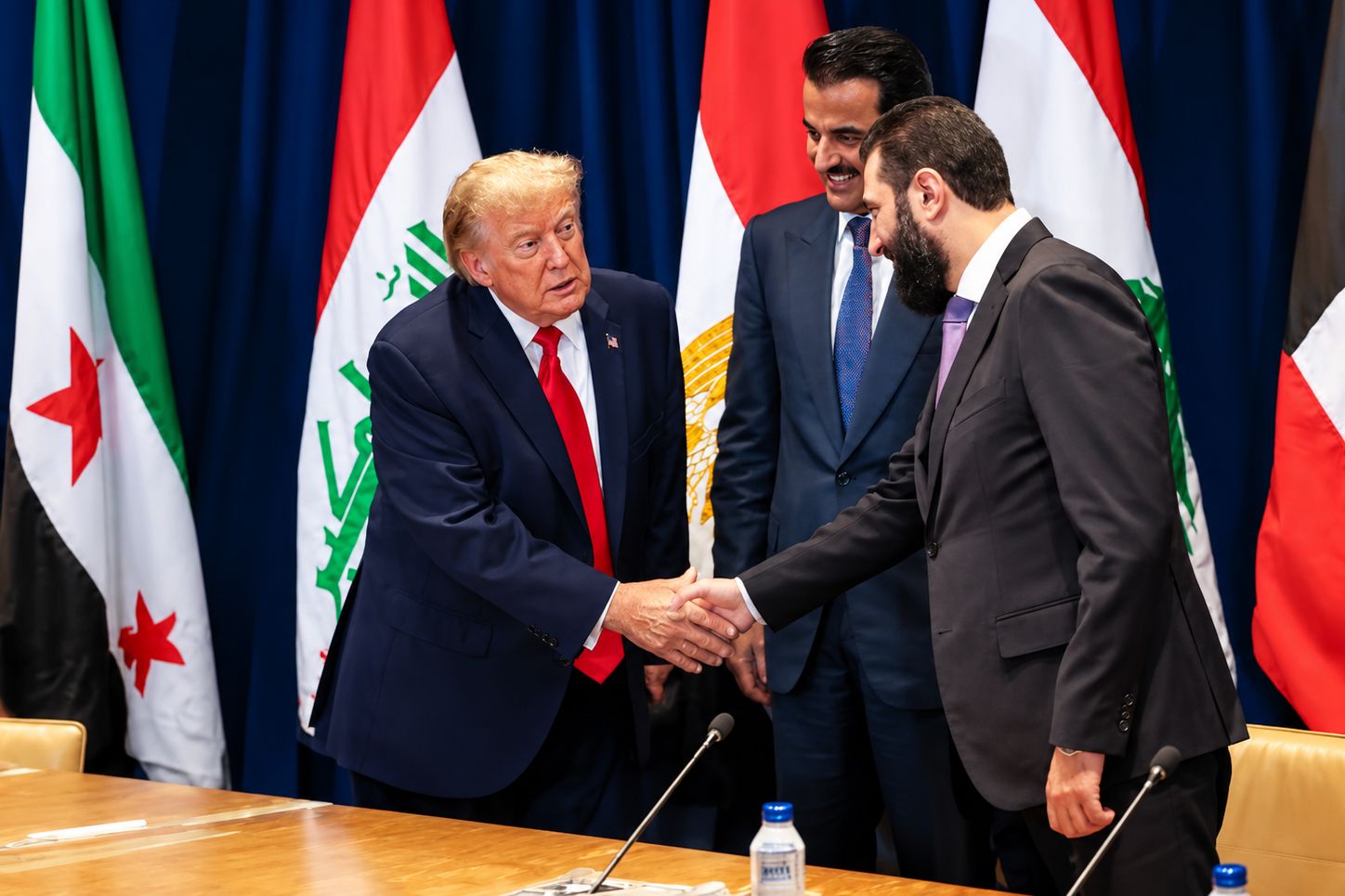
After years of financial isolation, Syria has begun testing opportunities to resume dealings with international banks. U.S. decisions easing sanctions opened the door legally, but opening that door does not mean banks will immediately walk through it. Between President Ahmed al-Sharaa’s meeting with President Donald Trump in New York, a banking meeting co-hosted by the U.S. Treasury, and the execution of a letter of credit to import fuel, signs of genuine, if still limited, change have emerged.
A Political Meeting Preceded by Sanctions Decisions
Al-Sharaa participated in the United Nations General Assembly meetings in September 2026 and met Trump on September 22 during a multilateral gathering of regional leaders. The meeting signaled an improvement in political relations, not a bilateral economic summit or the announcement of a new banking agreement. More importantly, sanctions relief did not begin with that meeting: the U.S. administration signed an order terminating the comprehensive sanctions program on June 30, 2025, which took effect on July 1. The Caesar Act was subsequently repealed on December 18, 2025, and Syria was removed from the U.S. list of state sponsors of terrorism on August 24, 2026.
According to the U.S. Office of Foreign Assets Control (OFAC), transactions with Syrian financial institutions are no longer generally prohibited, provided they do not involve parties on sanctions lists. However, targeted restrictions remain in place against figures associated with the former regime and entities involved in terrorism, drug trafficking, and human rights violations. This highlights the difference between lifting a general prohibition and eliminating all legal risks.
The Treasury Examines Requirements for Reconnection
On October 1, U.S. Treasury Assistant Secretary Jonathan Burke met with Syrian Finance Minister Mohammed Yusr Barnieh and Central Bank Governor Safwat Raslan, with U.S. financial institutions and payment-service providers participating. Envoy Thomas Barrack joined virtually. The Treasury said the discussion addressed shortcomings in anti-money-laundering and counterterrorism-financing systems and the steps Damascus is taking to remedy them.
Meetings of this kind matter because they give banks a clearer picture of the risks, but they do not oblige any bank to open an account or restore a correspondent banking relationship. A bank processing international transfers must verify the identities of the parties involved, the sources of funds, and the adequacy of compliance procedures. Banking-system reform therefore remains a practical requirement, not merely a political demand.
One Letter of Credit: What Does It Prove?
On October 11, the Central Bank of Syria announced the issuance of a letter of credit through a U.S. financial institution to support imports of petroleum products from Saudi Aramco. Nine days later, Reuters quoted a Syrian Petroleum Company official as saying that J.P. Morgan had confirmed the letter of credit and guaranteed its execution, and that the company had received 65,000 metric tons of diesel. The bank did not comment to Reuters on the transaction.
A letter of credit is an instrument that allows a commercial transaction to be settled with banking guarantees, reducing risks for buyers and sellers. For Syria, this could help secure fuel and other essential imports. But this transaction does not establish that a broad network of correspondent banking relationships has returned, nor does it mean that billions of dollars in new investment are flowing into the country. It is a specific transaction on which further progress could build if similar transactions take place in other sectors.
Congress Monitors What Follows the Opening
The issue goes beyond finance. During a September 21 meeting with al-Sharaa, Senator Jeanne Shaheen discussed the fight against ISIS, the protection of religious and ethnic communities, understandings with the Syrian Democratic Forces, and investment opportunities. Section 8369 of the National Defense Authorization Act for Fiscal Year 2026 also requires the U.S. administration to submit periodic reports to Congress on the Syrian government’s performance in counterterrorism, the protection of minority rights, understandings with the Syrian Democratic Forces, efforts to combat money laundering and terrorist financing, and other security and institutional matters.
Consequently, announcing reforms or signing understandings is not enough. The most important indicators are the number of banking relationships actually restored, the volume of transfers processed, progress in compliance procedures, investments that enter the implementation phase, and tangible results on security issues and minority rights.
A Test of Confidence
The World Bank estimated the cost of reconstructing Syria’s damaged physical assets at approximately $216 billion. This is an estimate of needs, not an investment pledge. The distance between that substantial figure and the first banking steps remains considerable. Washington has removed major obstacles, and Damascus has begun testing new payment channels, but confidence cannot be restored by a single decision. This process also highlights an important difference between financing specific imports and financing long-term projects. Investors need channels for transferring funds and settling payments, as well as clear, reliable rules, while regulators need data showing that transactions do not pass through prohibited parties. Actual results, rather than statements alone, will therefore remain the measure by which the value of the opening can be judged. What will determine the next phase is the ability of Syrian institutions to turn political opening into regular transactions and verifiable reforms.
Prepared by: Rana Hawa | Washington – Syria Morse News Network