

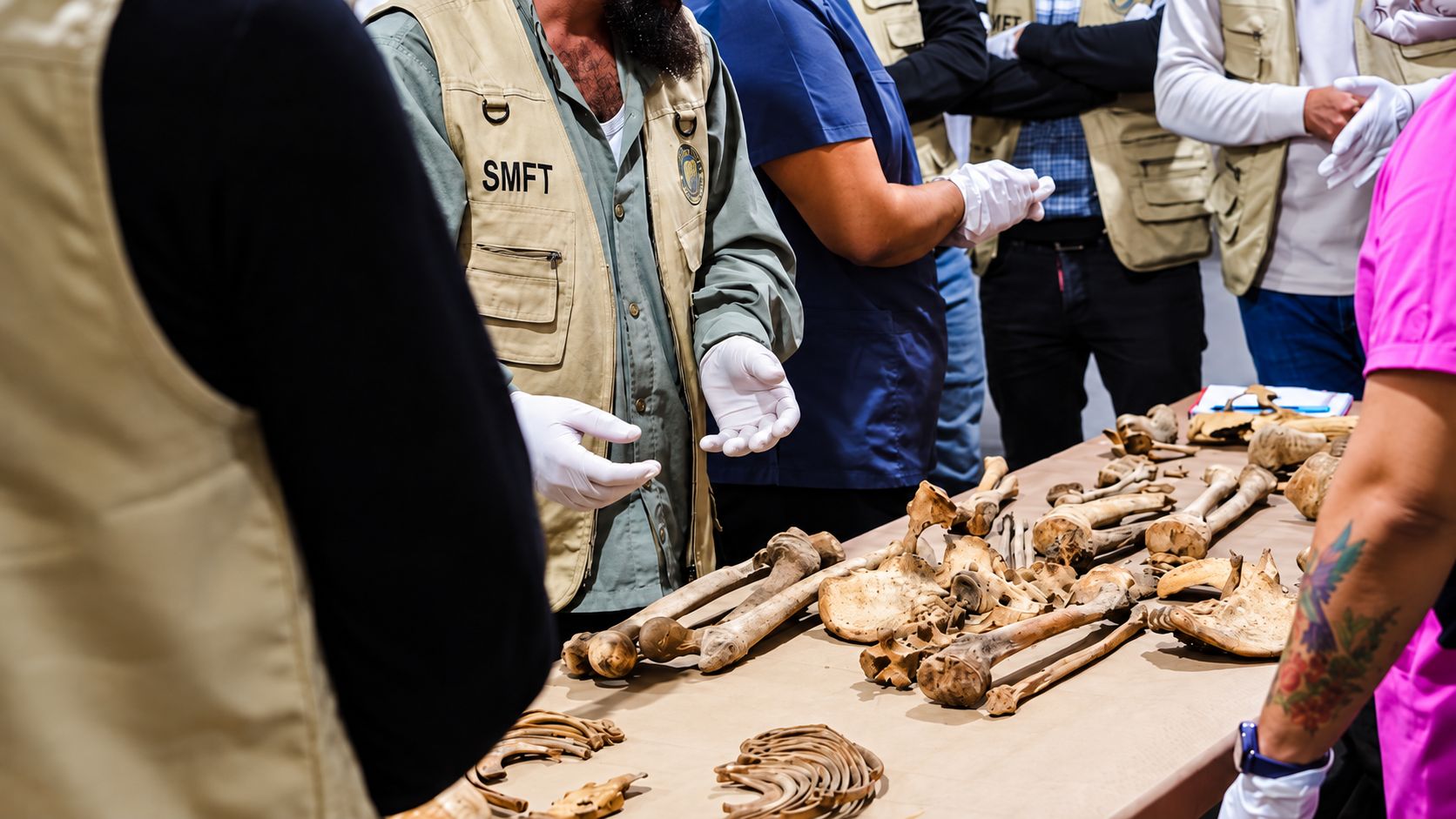
For the first time in Syria, DNA analysis has led to the identification of missing persons’ remains in three cases during 2026, a development that offers many families renewed hope of learning the fate of their loved ones. At the same time, it highlights the scale of the challenges involved in building a national system capable of addressing one of the country’s most complex humanitarian issues.
According to a Reuters report published on October 20, the National Commission for Missing Persons completed two identifications, while Syrian and international organizations carried out the third, which involved identifying seven members of a single family who went missing during the battles in Raqqa in 2017. These results do not mean that the broader issue of missing persons has been resolved, but they provide practical evidence that forensic evidence and genetic analysis can deliver long-awaited answers.
Nine Years of Waiting
One of the most prominent cases involves Manar Aliwi, who went missing with her husband and five children during the fighting in Raqqa in August 2017, when the family was sheltering inside a residential building destroyed in an airstrike suspected of having been carried out during military operations against ISIS.
According to the Syria Justice and Accountability Centre (SJAC), human remains were found among the building’s rubble in 2024 before being recovered and subjected to examinations and investigations with the participation of the Syrian Team for Missing Persons and Forensic Medicine. Documents found at the site, along with relatives’ testimonies and comparisons of clothing visible in family photographs, helped identify members of the family and locate relatives from whom the necessary reference samples could be collected.
After analyzing the samples and comparing them with information gathered by investigators, the Forensic Anthropology Foundation of Guatemala (FAFG) confirmed that the remains belonged to Manar Aliwi, her husband, and their five children. Surviving family members were informed of the results in September 2026, according to the Centre.
Mohammad Hamada, Manar’s son and the only surviving member of his immediate family, told Reuters that identifying the remains would allow the family to bury their loved ones and visit their graves, easing some of the uncertainty that had accompanied them for nearly nine years. Nevertheless, the fate of Manar’s father, who was also in the building according to information contained in the investigation, remains unresolved.
This case illustrates the human dimension of DNA identification. The issue is not limited to identifying remains; it also involves ending the period of waiting and enabling families to take practical steps, such as burial, death registration, and reclaiming their right to know the fate of their relatives.
From Reporting to DNA Matching
Data from the National Commission for Missing Persons, cited by Reuters, illustrate the scale of the work required to expand these initial results. The Commission has collected approximately 96,000 files from Syrian ministries and nongovernmental organizations, along with nearly 2,000 samples from human remains and 29 reference samples from relatives of missing persons in cases where indications of a possible match had emerged. Two of the cases handled by the Commission resulted in confirmed identifications.
According to the report, the Commission receives an average of 100 new reports daily through the Athar program, launched on August 30, 2026, to receive reports concerning missing and forcibly disappeared persons and contribute to the establishment of a national registry. However, reports, files, and samples do not constitute confirmed identifications; each serves a different purpose in the search and verification process.
The procedures begin with documenting information provided by families, followed by collecting evidence, protecting sites where remains are discovered, and recovering them in accordance with established procedures. Reference samples are then collected from relatives with their consent before analysis, comparison, and review of the results. This process requires documenting the chain of custody of evidence, maintaining quality control, and protecting biological and personal data to ensure the reliability of the findings and safeguard families’ rights.
Identifying remains does not, in itself, establish the cause of death or the party responsible. These matters require separate evidence and investigations and may fall within independent judicial and criminal proceedings.
Laboratories Under Development and International Partnerships
As part of efforts to strengthen local capabilities, the International Commission on Missing Persons (ICMP) announced on September 18, 2026, that experts from the National Commission for Missing Persons had completed training in The Hague from September 14 to 18. The training covered stages of laboratory DNA analysis, genetic profile comparison, and quality assurance, alongside discussions on developing a specialized national laboratory.
Reuters reported that the Commission is working with the International Committee of the Red Cross to establish a DNA analysis laboratory expected to be completed by May 2027. It is also working on a second laboratory project in cooperation with the International Commission on Missing Persons, with support from the European Union.
The announcement of these projects does not mean that a fully integrated national laboratory network is already operational. Building technical capabilities, providing equipment, training personnel, and developing databases will continue to require time, coordination, and sustainable resources.
The organizations involved perform complementary but distinct roles. The National Commission carries out institutional responsibilities related to missing persons, while humanitarian and human rights organizations and specialized forensic teams contribute to documentation, analysis, and family support, each within its area of expertise. Coordination and information sharing under clear safeguards remain essential to avoiding duplicate records and ensuring that families are not excluded from the search process.
Wide-Ranging Estimates and Continuing Needs
UN estimates of the number of missing persons in Syria range from 130,000 to 300,000, according to the Reuters report. This range reflects the scale of the crisis but does not constitute a unified final count, nor does it mean that all cases have been documented or that the fate of those involved is known.
The case of the family in Raqqa remains an example of what DNA identification techniques can achieve in a specific case. The broader missing-persons crisis in Syria, however, extends to cases of enforced disappearance and detention linked to practices of the former regime, as well as people missing in connection with the conflict, migration, and other causes.
Identification efforts face challenges that include difficulty accessing certain sites, variations in the quality of available evidence, the need to collect samples from relatives, and shortages of specialized expertise and equipment. There is also a need to provide legal, psychological, and social support to families who have endured years of uncertainty.
The effects of disappearance are not limited to the absence of the missing persons themselves. The International Committee of the Red Cross documents long-term psychological, economic, and legal burdens faced by families because of continuing uncertainty about the fate of their loved ones. Many women shoulder additional responsibilities for supporting their families, caring for children, and continuing the search for missing relatives, as documented by the International Commission on Missing Persons. This makes clarifying the fate of missing persons part of addressing broader social and humanitarian consequences.
What Can These Results Offer the U.S. Congress?
For the U.S. Congress, these results provide an opportunity to assess options for supporting technical capabilities, international cooperation, and evidence protection within the areas of human rights, transitional justice, and foreign assistance. This could include examining opportunities for specialized training, supporting evidence documentation and data protection procedures, strengthening coordination between Syrian institutions and international organizations, and expanding legal and psychological services available to families.
However, these options remain proposals for consideration and do not, in themselves, establish the existence of new U.S. funding or an approved financial commitment to establish laboratories.
The identification of seven members of one family, alongside the two identifications completed by the National Commission, represents tangible progress in the missing persons file, but it is not a comprehensive solution to the crisis. Turning these results into a sustainable process will depend on building trustworthy institutions, ensuring the independence and accuracy of procedures, protecting families’ privacy, and providing them with equal access to search services.
The true measure of progress will not be the number of DNA matches alone, but the ability of institutions to continue searching transparently, provide families with reliable answers, and respect their right to know the fate of their loved ones and bury them with dignity.
Prepared by: Hani Hashem