In a nation torn apart by war, where deep divisions have widened between its people, their ideas, sects, and beliefs, the first sprouts of democracy are now emerging.
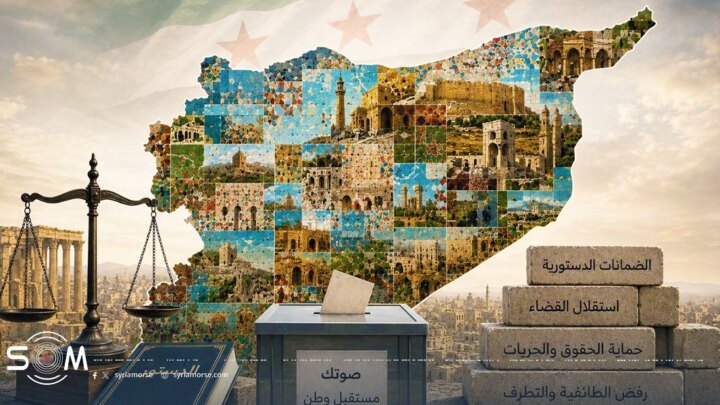
Can Syria – a country that carries within its body all the diversity of the East along with many of its wounds – cultivate the most beautiful form of governance that expresses this diversity instead of destroying it? A country that emerged from years of blood, oppression, and fragmentation is not only seeking to restore governance, but to create a new democratic model suited to its reality, at an appropriate pace, and to teach the world how differences and divergences can transform from mines of hatred and tools for opportunists into beautiful, colorful pillars of construction, inlaid with the stones of a vibrant mosaic.
A Vision of Shared Protection
Imagine for a moment: In a village in the Aleppo countryside, an Alawite sheikh sits beside a Sunni imam, a Christian priest, a Kurdish female engineer, a Druze young man who returned from Germany, and a former opposition figure from Damascus. They are not debating who should rule, but how to protect one another so that no new dictator can ever rule them through fear again. This moment is not a romantic dream – it is the real challenge facing the nation at this critical stage.
Designing a Democracy Rooted in Syrian Realities
How do we create a democracy unique to the new Syria – one whose goals spring from the core values of the Syrian revolution? We must benefit from the experiences of other nations while avoiding distorted copies built on unfair foundations.
I do not hide my optimism. Syria possesses what many transitional experiences after revolutions have lacked: a profound diversity that makes any form of long-term dictatorship virtually impossible.
The repression practiced by the former regime proved the failure of imposing a single sectarian identity on a country that contains every color of the human spectrum.
Today, after everything has been destroyed, we have a rare opportunity: to thoughtfully build a democracy on solid foundations for a sustainable life. Its pillars should not rely on blind trust, but on a balance of interests, mutual guarantees protected by law, customs, and ethics – where diversity itself becomes the guarantee of long-term stability.
No Victor, No Vanquished
The first steps of democracy cannot begin with a total victory of one side over another. True victory, if achieved, belongs to the entire homeland and all its loyal sons and daughters. There are no real winners and losers here.
Talking about balance and guarantees does not mean marginalizing Syria’s Sunni majority, which paid the highest price during more than fifty years of oppression, exclusion, and destruction. On the contrary, we want an inclusive nation and a government that protects the rights of all its children. We do not want to marginalize anyone, nor will we accept anyone’s marginalization.
In a true and fair democracy, the Sunni majority will not be marginalized – quite the opposite. Free and fair elections will finally do justice to this majority after decades of falsified numbers and rigged votes. However, real democracy does not mean “the dictatorship of the majority.” It means genuine representation of the majority without turning minorities into second-class citizens.
We fully recognize that Sunnis in Syria suffered the harshest tyranny and that their blood flowed most heavily on the altars of the former regime. Precisely for this reason, we do not want to reproduce injustice in a new form. We want democracy to be a guarantee for preserving rights and listening to all voices.
In this one homeland, there is no room for sub-identities and affiliations that exclude and divide. Every Syrian must rise above their religious or sectarian identity and carry, first and foremost, their unifying Syrian national identity.
Extremism Is the Common Enemy
We all recognize that extremism in all its forms – religious, political, or sectarian – is a shared enemy of all Syrians. Everyone has tasted its bitterness. Extremism does not build a nation; it burns it. Therefore, any genuine democratic project must decisively end all forms of extremism and exclusion.
Positive Signs and Serious Challenges
Despite positive indicators in recent times – efforts to protect minorities, clear willingness to represent diversity within authority, acceptance of the other, and flexibility in opening participation to all – reality forces us to acknowledge the difficulty of the task.
The repressive policies of the fallen regime, accumulated outdated ideas, widespread injustice, and the generational transmission of sectarianism from grandfather to father to son to child have made uprooting sectarian and discriminatory thinking a practical challenge. Changing ideas formed over decades cannot be achieved through good intentions or a new constitution alone.
Democracy is not built by laws alone, but fundamentally by a new human being. The weakest form of faith is for each of us to begin with ourselves, our families, and our children – focusing on belonging to the nation first, along with forgiveness and brotherhood. Awareness is a cornerstone in building the new Syrian democracy.
We must focus strongly on childhood and youth, because the future ultimately belongs to them. New educational curricula, community awareness programs, and cultural and media initiatives are essential to rebuild lost trust.
The child who grows up seeing his classmate as a “Syrian” rather than a “sectarian” is the one who will build the tomorrow we dream of.
Which Democratic System Suits Syria Today?
No single democratic model is perfect. Each is shaped by its historical, cultural, and social context.
• United States: Presidential system with strict separation of powers.
• United Kingdom: Parliamentary system with high flexibility.
• Germany: Parliamentary system emphasizing consensus and federalism.
• France: Hybrid semi-presidential system offering a balance between strong executive stability and parliamentary accountability.
A Semi-Presidential System for Syria?
For a country with Syria’s ethnic and sectarian diversity, a carefully tailored semi-presidential system(inspired by the French model) appears most suitable. It would feature:
• A strong president who safeguards national unity.
• A parliament that ensures accountability and broad participation.
• Strong constitutional guarantees: real separation of powers, judicial independence, explicit protection of minority rights, and clear transitional time limits.
The new Syrian constitution should include proportional representation in parliament, direct presidential elections with a runoff round, an independent Supreme Judicial Council, and permanent parliamentary committees for minority rights. It must explicitly ban sectarian speech and incitement to hatred, while fostering a deep ethical and cultural rejection of these phenomena through education, media, and national initiatives.
Why Federalism Is Not Suitable Now
Although some see federalism as a possible solution for national reconciliation, it currently appears unfeasible for intertwined political, security, social, and economic reasons. The country lacks minimum security stability and inter-component trust. Without genuine reconciliation and transitional justice, federalism could turn regions into fragile sectarian mini-states and encourage separation rather than unity – especially given the unequal distribution of oil and economic resources.
Syria also suffers from weak institutions, widespread poverty, and destroyed infrastructure. Successful federalism (as in Germany or Canada) requires strong institutions and fair resource management – conditions not yet present.
External interventions further complicate the matter. Therefore, administrative decentralization should only be considered after achieving tangible progress in building a unified national army, a consensual constitution, sectarian reconciliation, and economic recovery.
Main Challenges Facing Syria’s Democratic Transition
• Deep sectarian and ethnic divisions
• Armed factions and militias
• Devastated economy and massive reconstruction needs
• Regional threats
• Lack of democratic experience after decades of dictatorship
• Security threats, terrorism, and the risk of chaos amid poverty
Democracy in Syria is neither impossible nor distant, but it requires a well-planned transition that combines strong executive authority for stability with broad participation for legitimacy.
A semi-presidential system with conditional future decentralization and strong unifying central authority during the transitional period may be the most appropriate model – alongside comprehensive national dialogue, independent institutions, and robust protection for minorities.
I see the new Syria as a truly beautiful mosaic painting – despite its painful past and current challenges. It undoubtedly deserves a democratic system that reflects its diversity and secures a shared future for all its sons and daughters.