
Presidential Decree No. 163 gave students in Suwayda Governorate who were unable to complete their 2026 examinations an opportunity to sit for an exceptional examination session. However, difficulties reaching examination centers prevented some students from benefiting from the measure. The events surrounding the start of the examinations highlight the gap between legally providing access to education and the ability to exercise that right in practice amid restrictions on freedom of movement and security concerns.
When Presidential Decree No. 163 was issued on August 19, 2026, it appeared that thousands of students in Suwayda had finally been given an opportunity to salvage an academic year they had been unable to complete. But the start of the exceptional examination session demonstrated that granting students a legal right to sit for an examination does not necessarily mean they can safely reach the examination hall.
The decree granted students in Suwayda Governorate who had not sat for the 2026 examinations, or who had been unable to complete all of their subjects, an exceptional examination session for the Basic Education Certificate and the General Secondary Education Certificate in all branches, under the applicable rules and conditions. The Ministry of Education set August 29 as the starting date, with examinations continuing into early September depending on the certificate and academic track.
The need for the exceptional session arose after approximately 13,500 students from Suwayda were unable to sit for the previous round of national examinations, according to a briefing by Deputy U.N. Special Envoy for Syria Claudio Cordone to the Security Council in June. The United Nations said at the time that the majority of students in the governorate had consequently missed their examinations for two consecutive years.
Examination Centers Were Ready, but Access Remained Difficult
To implement the decree, the Ministry of Education prepared examination centers in northern rural Suwayda. The announced number increased during preparations from 24 centers capable of accommodating approximately 13,000 students to 27 centers once preparations were completed shortly before the examination session began. The ministry said the centers had met the necessary requirements to receive students, but the problem shifted from inside the examination halls to the roads leading to them.
On the morning of August 29, the start of the examinations was delayed until 11:00 a.m. after buses carrying students and supervisors encountered difficulties traveling between Suwayda city and examination centers in the northern countryside. The Ministry of Education said it had taken measures to provide students with additional time to arrive, while expressing regret that not all students were able to reach the centers.
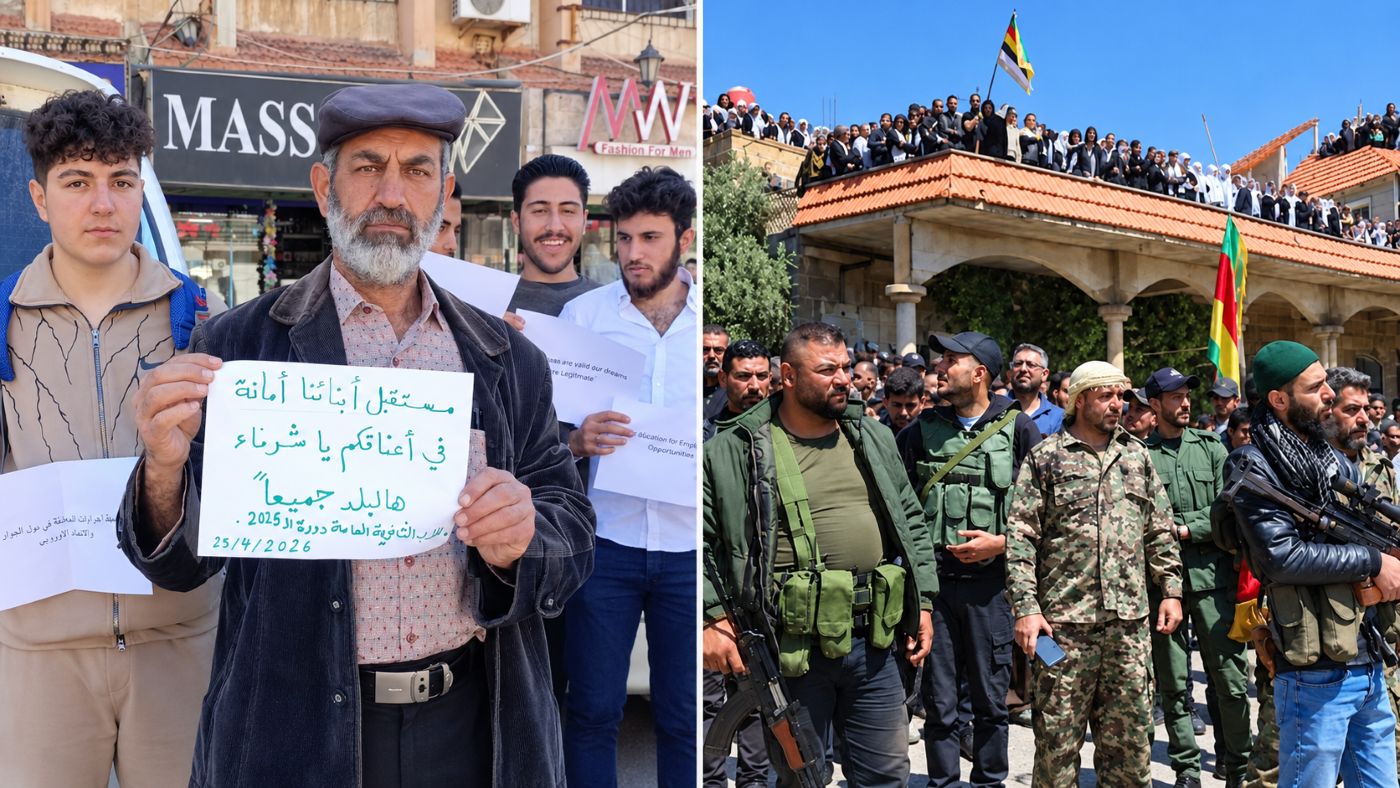
According to media reports, groups of students and parents objecting to the location of the examination centers, along with armed individuals whom those reports said were affiliated with the so-called “Shahba Operations Room,” blocked several points along the road, including the Shahba checkpoint and al-Anqoud roundabout, preventing buses from continuing. Media reports also described gunfire into the air and verbal abuse directed at students and parents attempting to reach the examination centers.
Several students who spoke to Syria Morse News Network on condition of anonymity said they were aboard a bus in Suwayda city when an armed group arrived and threatened the students in an effort to prevent them from traveling north. They said some members of the group fired into the air after the students insisted on continuing their journey.
Competing Accounts Over Responsibility for the Road Closures
Suwayda Governor Mustafa al-Bakour, meanwhile, said that “outlaw groups” had prevented students from leaving the city for their examination centers. He added that approximately 150 students were able to sit for their examinations after some had left areas controlled by local groups several days earlier in order to avoid potential obstacles to reaching the centers.
The so-called “National Guard” militia in Suwayda later denied responsibility for preventing students from traveling to the examinations, saying that a position issued by the “Shahba Operations Room” did not represent it. Local reports also said opposition to the examination centers was related to their location in northern parts of the governorate and to security concerns, with calls for examinations to be held in areas closer to the students.
Access difficulties continued the following day, according to several media sources, which reported that the road remained closed to students seeking to reach the examination centers. One report said that some students who were able to sit for their examinations had left Suwayda for Damascus and its countryside before the examination session began in order to avoid obstacles along the roads.
United Nations Position
The United Nations addressed the matter as a civil right extending beyond the dispute over the location of the examination centers. In a statement issued on August 29, U.N. Resident Coordinator and Acting Humanitarian Coordinator in Syria Marianne Ward welcomed the decree but expressed concern over reports that students had been prevented from reaching their examination centers and that their movement had been restricted. She called on the relevant parties to enable children, with the support of their parents, to exercise their right to education and examinations without pressure or obstruction.
Policy Relevance
The experience of Suwayda’s exceptional examination session demonstrates that establishing legal and administrative arrangements for access to education does not, by itself, ensure that students can exercise that right when restrictions on freedom of movement or security conditions impede access to educational institutions.
For congressional review, key indicators include the ability of authorities and local actors to ensure that students can reach examination centers without threats or obstruction, preserve freedom of movement and access to education, and establish practical arrangements that prevent students from losing additional academic years because of security and political conditions.
For the students, the issue extends beyond simply sitting for an examination. An inability to reach the examination center could mean losing another academic year, delaying entry into university or vocational education, and imposing additional psychological and financial burdens on their families.
Suwayda’s exceptional examination session therefore presents a test that extends beyond the decree itself to a broader question: Can the legal right to education be transformed into a right that can actually be exercised? Success is measured not only by the number of examination centers prepared or examinations administered, but by whether students can reach their centers freely and safely, sit for their examinations, and return to their families without fear or coercion.
By Hani Hashem