

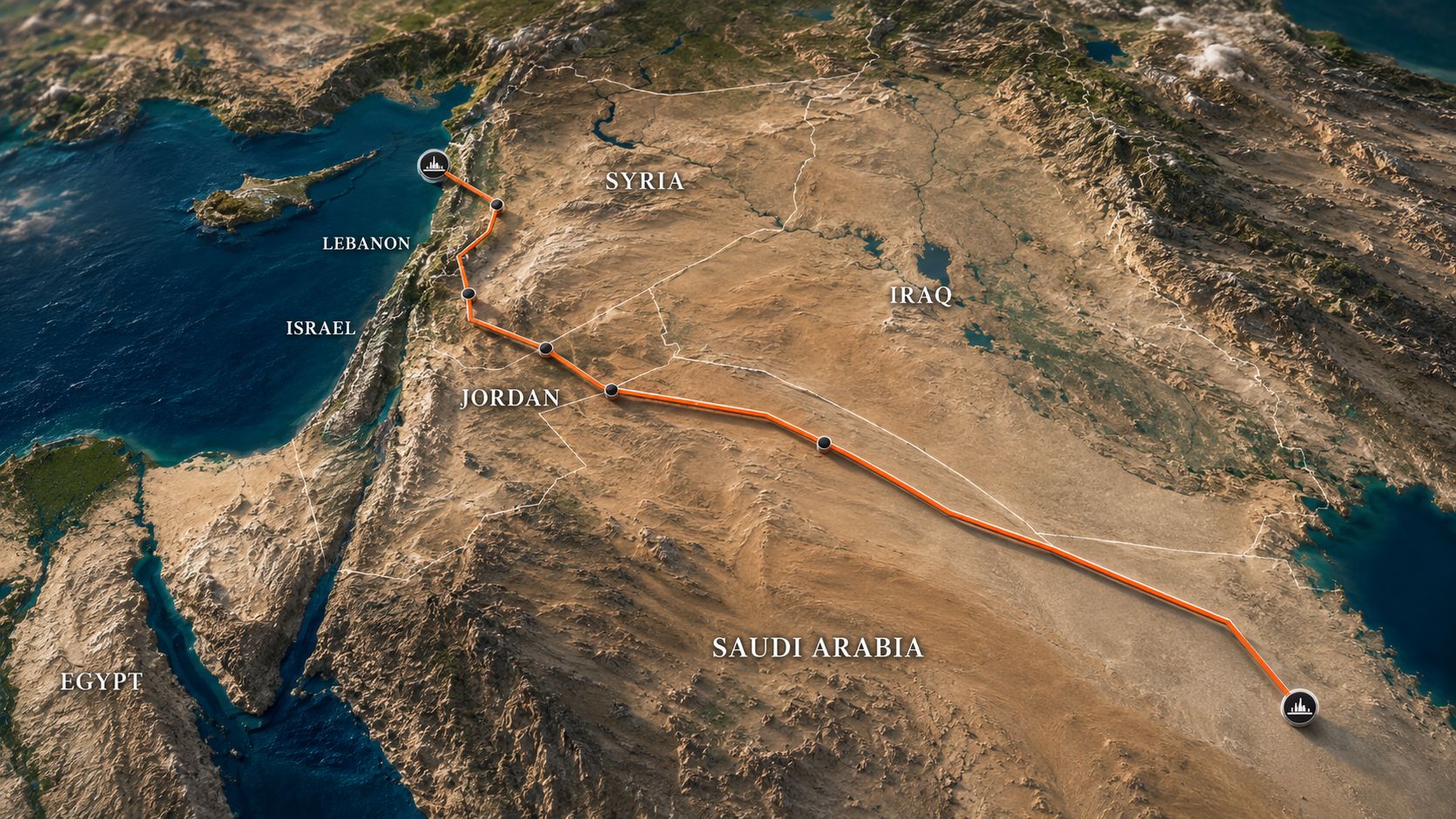
Syria’s attempt to present itself as a safe and neutral corridor reflects both opportunity and fragility. Its relative calm amid regional escalation may support limited logistical and security roles, but the corridor remains exposed to conflict spillover, compliance risks, and unresolved regional pressures.
After fourteen years of war, and amid regional escalation linked to the confrontation with Iran and disruption of traditional energy routes, Damascus is attempting to present itself as a potential safe and neutral route for trade and energy shipments. This positioning is based on Syria’s continued avoidance of direct involvement in the conflict so far, along with the emergence of overland transport activity toward Syria’s coast and the port of Baniyas.
This does not mean Syria has become fully secure. Rather, it reflects a limited political and logistical proposition: using Syria’s geography as an alternative route while traditional corridors face regional pressure. For Congress, the issue is relevant to energy security, counter-ISIS operations, the U.S. presence in the region, border stability, sanctions policy, and compliance.
What Is Meant by a Safe and Neutral Corridor?
The phrase “safe and neutral corridor” does not mean that Syria is free of risk. It refers to Damascus’s effort to present itself as a space not directly involved in the war and capable of providing an alternative overland route for energy shipments and trade.
According to the Associated Press, hundreds of oil-laden trucks, some arriving from Iraq, lined the Syrian coastal road toward the port and refinery of Baniyas, waiting to unload cargo into tankers on the Mediterranean. This followed the closure of the Strait of Hormuz, which pushed some shipments to move overland from Iraq into Syria.
The report also noted the reopening of a major border crossing between northern Iraq and Syria after more than a decade of closure, presenting it as a possible additional route for energy exports. Although overland transport is less efficient and more costly than shipping through the strait, it offers a temporary alternative while traditional energy routes remain under pressure.
Damascus’s Stated Neutrality
During the latest regional escalation, Damascus has shown a clear interest in staying out of direct confrontation. This position has helped Syria appear as one of the few areas maintaining relative calm in a highly tense regional environment.
This neutrality does not eliminate risk, but it is an important security indicator: Syria’s ability, so far, to avoid becoming again a theater for regional conflict. For Washington, this indicator deserves attention because it relates to border stability, the safety of overland routes, and escalation risks involving Israel, Iran, and their allies.
Logistical and Security Dimensions
The port and oil refinery of Baniyas have become central to Syria’s effort to present itself as an alternative route for energy shipments. This role is not only commercial; it also carries a security dimension because it tests the Syrian state’s ability to protect land routes, manage ports, and preserve relative calm during regional escalation.
At the same time, these developments do not guarantee economic recovery or long-term investment. Overland transport remains more costly and less efficient than traditional maritime routes, and any commercial activity through Syria will remain tied to security, stability, and legal compliance considerations.
For Washington, the importance of this route is not only that it may serve as a temporary alternative for energy shipments, but also what it reveals about Syria’s ability to reduce some effects of regional escalation without becoming a direct party to the conflict.
Security and Political Risks
Syria’s declared neutrality does not remove the risks created by its geography. The country sits between Lebanon, Iraq, Turkey, and Israel, all connected in different ways to wider regional tension. Hezbollah activity, Iran-backed factions, and Israeli strikes remain factors that could pull Syria back into escalation.
In the northeast, the January extension of the ceasefire between Syrian forces and the Syrian Democratic Forces was an important indicator of efforts to contain internal tensions. France, Germany, the United Kingdom, and the United States welcomed the extension and urged compliance, while emphasizing the need to avoid security gaps around counter-ISIS operations and detention facilities.
Even if Syria remains outside direct confrontation, it is still exposed to spillover risks, including missile or debris impacts, closure of airspace or airports, economic pressure, border tensions, or extremist groups exploiting any security vacuum. For that reason, Syrian neutrality is a positive indicator, but one that requires careful security monitoring.
The View from U.S. Policy
For U.S. policymakers, Syria’s evolving role raises questions related to regional security, counter-ISIS operations, energy security, and legal compliance. On June 30, 2025, President Donald Trump issued an executive order ending comprehensive U.S. sanctions on Syria effective July 1, 2025, while maintaining sanctions on Bashar al-Assad and his associates, human rights abusers, Captagon traffickers, individuals linked to ISIS and al-Qaeda, and Iran and its proxies.
A separate Caesar Act track also unfolded in 2025, beginning with a temporary 180-day waiver in May and ending with legislation repealing the law in December. However, some U.S. restrictions and Syria-related designations remain in place, meaning any new Syrian role in commercial transport or energy routes will continue to face legal and political scrutiny.
These changes do not remove all restrictions or risks, but they create limited space for conditional engagement. For Congress, the key issue is whether Syria’s role as a safe and neutral corridor can support regional stability without weakening accountability tools or creating compliance gaps.
What Remains Unclear
Several questions require continued monitoring:
- Can Syria maintain neutrality if regional escalation expands or if it faces direct attacks?
- Does the Syrian government have sufficient capacity to control its borders and prevent external actors or armed groups from using its territory?
- How will Israel, Iran, and their allies respond to Syria’s emerging role as a transit corridor?
- How far will Iraq and Gulf states accept this route if it continues?
- How will Washington approach any new Syrian role in transportation, energy security, and regional stability?
These questions matter for Congress because the issue is not only about a potential commercial corridor. It is also about Syria’s ability to maintain neutrality, secure land routes, and prevent its geography from becoming a new source of escalation.
In conclusion, Syria’s attempt to present itself as a safe and neutral corridor reflects both opportunity and fragility. Damascus has benefited from staying outside direct regional confrontation and has begun to appear as a potential corridor for energy shipments and trade. Yet its role remains surrounded by security, political, economic, and compliance risks. Syria’s relative calm is an important indicator, but not a guarantee of lasting stability, making this corridor a development to monitor rather than a settled outcome.
By Hani Hashem
SMNN Reporter – Damascus, Syria