

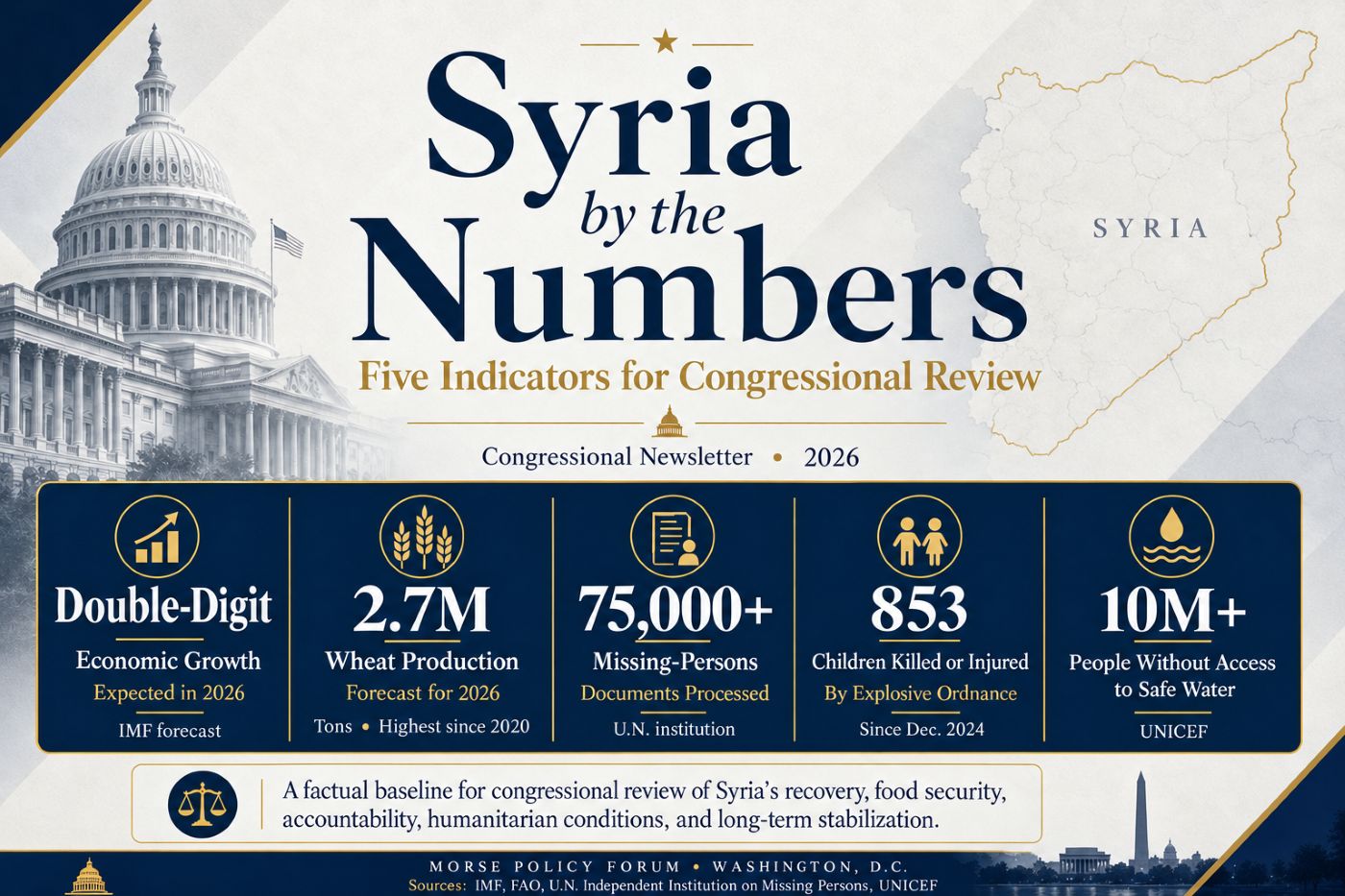
Five public indicators illustrate both the momentum and the limits of Syria’s recovery. The IMF expects double-digit economic growth in 2026, while FAO forecasts the strongest wheat harvest since 2020. At the same time, the United Nations has accelerated work on Syria’s missing-persons file, while explosive ordnance has killed or injured 853 children since December 2024 and more than 10 million people remain without access to safe water. Together, these figures provide Congress with measurable reference points for assessing economic recovery, food security, accountability, humanitarian conditions, and long-term stabilization.
Syria by the Numbers
Double-Digit
Economic Growth Expected in 2026
The IMF expects Syria’s economy to achieve double-digit growth in 2026, although poverty remains widespread and recovery is uneven across regions.
2.7M Tons
Wheat Production Forecast
FAO forecasts Syria’s 2026 wheat production at 2.7 million tonnes, more than 50 percent above the five-year average.
75,000+
Missing-Persons Documents Processed
The U.N. Independent Institution on Missing Persons processed more than 75,000 documents over the past year.
853
Children Killed or Injured by Explosive Ordnance
UNICEF reports 252 children killed and 601 injured by explosive ordnance since December 2024.
10M+
People Without Access to Safe Water
More than 10 million people lack access to safe water as damaged infrastructure and climate pressures continue to strain essential services.
Syria’s transition presents two trends at the same time: measurable improvements in economic and agricultural capacity, and persistent humanitarian and institutional challenges inherited from years of conflict. No single statistic captures the trajectory on its own, but together these indicators provide a factual baseline for assessing whether national-level recovery is translating into durable improvements in security, public services, accountability, and living conditions.
1. Double-Digit Economic Growth Expected in 2026
Number: The IMF expects Syria’s economy to achieve double-digit growth in 2026, with strong growth projected to continue in 2027.
Source: International Monetary Fund — August 4, 2026.
The IMF attributes the projected expansion to several areas of the economy. Agriculture is recovering following improved rainfall, hydrocarbon production and electricity provision are expanding, and activity in trade and services continues to grow. The return of refugees, increased visitor numbers, and policies aimed at restoring macroeconomic stability are also supporting economic activity.
The projection does not mean that economic recovery is complete. The IMF cautions that growth remains uneven across regions and that poverty, although somewhat reduced, remains widespread.
For congressional review, the growth outlook provides a measurable indicator of Syria’s economic recovery following years of contraction and isolation. The longer-term significance will depend on whether growth becomes broadly distributed, produces employment and investment, and translates into sustainable improvements in household living conditions.
2. Wheat Production Is Forecast at 2.7 Million Tonnes
Number: FAO forecasts Syria’s 2026 wheat production at 2.7 million tonnes, more than 50 percent above the five-year average and the highest level since 2020.
Source: FAO GIEWS Syria Country Brief — August 28, 2026.
The forecast represents a significant rebound from the drought-affected 2025 harvest. Improved rainfall beginning in December 2025 supported crop recovery across much of Syria’s principal agricultural areas, despite localized flooding and crop damage in parts of Raqqa, Deir ez-Zor, and Aleppo.
Higher domestic wheat production can reduce some pressure on imports and strengthen domestic food availability, although FAO continues to identify acute food insecurity as a major concern and expects Syria to retain substantial cereal import requirements.
For congressional review, wheat production provides a measurable indicator of agricultural recovery and food-system resilience. Its sustainability will depend on rainfall, irrigation, access to agricultural inputs, infrastructure, market conditions, and the ability of farmers to maintain production beyond a single favorable season.
3. More Than 75,000 Missing-Persons Documents Have Been Processed
Number: The U.N. Independent Institution on Missing Persons in the Syrian Arab Republic processed more than 75,000 documents over the past year—more than nine times the volume processed during the previous reporting period.
Source: U.N. Independent Institution on Missing Persons in the Syrian Arab Republic — 2026 General Assembly briefing.
The Institution was established by the U.N. General Assembly to clarify the fate and whereabouts of missing persons in Syria and support their families. Processing larger volumes of documentation is part of building the analytical systems needed to connect information across thousands of cases and ultimately provide answers to families.
The figure represents institutional processing capacity rather than the number of missing persons identified or cases resolved. Clarifying individual cases remains a complex process involving documentation, data integration, family engagement, and cooperation among Syrian and international institutions.
For congressional review, progress on the missing-persons file is relevant to transitional justice, accountability, family rights, reconciliation, and the credibility of institutions established to address abuses and unresolved consequences of the Syrian conflict.
4. Explosive Ordnance Has Killed or Injured 853 Children
Number: UNICEF reports that explosive ordnance has killed 252 children and injured 601 since December 2024, for a combined total of 853 child casualties.
Source: UNICEF — Syrian Arab Republic 2026 Humanitarian Action for Children Appeal.
Explosive remnants of war continue to pose a physical threat even where active hostilities have declined. Unexploded ordnance can restrict access to homes, schools, farmland, roads, and public infrastructure and creates particular risks for children and families returning to previously contested areas.
The casualty figure illustrates an important distinction between reduced active conflict and actual civilian safety. Stabilization requires not only fewer hostilities but also the identification, clearance, and risk management of explosive contamination left behind by the conflict.
For congressional review, explosive-ordnance contamination is relevant to humanitarian assistance, demining and clearance programs, child protection, the safety of refugee and internally displaced-person returns, agricultural recovery, and broader stabilization policy.
5. More Than 10 Million People Lack Access to Safe Water
Number: UNICEF reports that more than 10 million people in Syria lack access to safe water.
Source: UNICEF — Syrian Arab Republic 2026 Humanitarian Action for Children Appeal.
Syria’s water challenge reflects the combined impact of damaged infrastructure, inadequate sanitation and hygiene systems, water scarcity, and climate-related pressures. UNICEF warns that these conditions contribute to water-borne disease risks and place additional strain on communities already facing economic and humanitarian pressures.
Access to reliable water is also directly connected to the sustainability of population returns. Communities receiving returning refugees and internally displaced people require functioning water networks and basic services if returns are to remain viable over the longer term.
For congressional review, water access is relevant to humanitarian assistance, infrastructure rehabilitation, public health, climate resilience, stabilization programming, and the durability of refugee and internally displaced-person returns.
Policy Relevance
Taken together, these five indicators show that Syria’s transition contains measurable signs of economic and productive recovery alongside substantial unresolved humanitarian and institutional risks.
Double-digit projected economic growth and the rebound in wheat production indicate improving economic and agricultural capacity. The increased processing of missing-persons documentation reflects expanding institutional work on one of the most significant unresolved consequences of the Syrian conflict.
At the same time, child casualties from explosive ordnance and the scale of inadequate access to safe water demonstrate that improved national indicators have not eliminated risks facing Syrian households and returning communities.
For congressional review, these statistics provide measurable reference points for evaluating U.S. humanitarian assistance, stabilization policy, economic engagement, sanctions and reconstruction policy, accountability efforts, and broader U.S. interests in Syria’s long-term stability. Future assessments will depend on whether economic gains become durable and broadly distributed while humanitarian risks and infrastructure deficits decline.
By Morse Policy Forum
SMNN Congressional Newsletter