

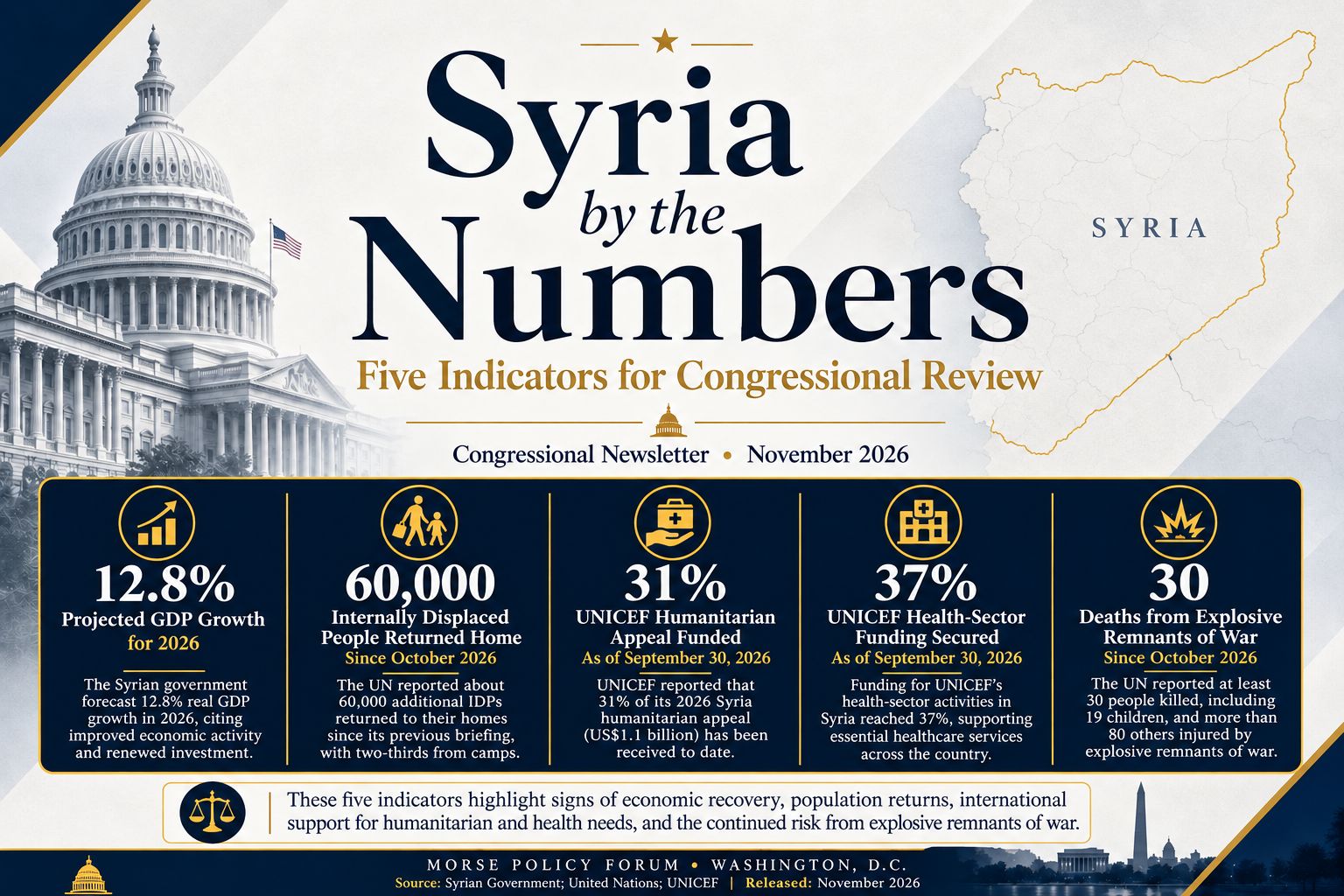
Five indicators released in November 2026 illustrate contrasting aspects of Syria’s recovery. The finance minister forecast 12.8% real GDP growth for 2026, while the United Nations reported that another 60,000 internally displaced Syrians had returned home since its October Security Council briefing. A UNICEF report published November 3 showed that its Syria humanitarian appeal was 31% funded and its health-sector activities were 37% funded as of September 30. At the November 16 Security Council briefing, the UN also reported at least 30 deaths from explosive ordnance since the previous meeting, including 19 children. For congressional review, the figures distinguish projected economic gains and population returns from funding shortfalls and continuing civilian risks.
Syria by the Numbers — November 2026
12.8%
Government Forecast for 2026 Real GDP Growth
A November 17 forecast by Syria’s finance minister; not a measured full-year growth rate.
60,000
Additional Internally Displaced People Returned
UN-reported returns since the October Security Council briefing; about two-thirds came from camps.
31%
UNICEF’s 2026 Syria Humanitarian Appeal Funded
Funding recorded through September 30; released in UNICEF’s November 3 situation report.
37%
UNICEF Health-Sector Activities Funded
UNICEF’s own health response funding status as of September 30; not the nationwide health-sector total.
30
Deaths From Explosive Ordnance Since October Briefing
The UN reported at least 30 fatalities, including 19 children, in its November 16 update.
The five measures are drawn from three releases during November 1–22: UNICEF’s November 3 report, the UN’s November 16 Security Council briefing, and Reuters’ November 17 account of the Syrian finance minister’s outlook. They describe different kinds of evidence. The economic figure is a forward-looking official forecast; the two UNICEF percentages describe funding as of September 30; the return and casualty figures are newly reported changes since the preceding October Council meeting. They should therefore be read as separate indicators rather than a composite score of Syria’s recovery.
1. 12.8% Real GDP Growth Forecast for 2026
Number: On November 17, 2026, Syrian Finance Minister Yisr Barnieh forecast 12.8% real gross domestic product growth in 2026 at the Syria Partnership Cooperation Forum in Damascus.
Source: Reuters — November 17, 2026.
The figure reflects the government’s economic outlook amid efforts to attract investment and restore international commercial ties. Reuters also reported discussions of European investment and technical cooperation at the forum. The projection offers a reference point for the direction of official economic expectations.
The 12.8% figure is a forecast, not a published measurement of completed 2026 economic performance. Reuters reported that the minister did not identify the main drivers behind the expected growth. The figure therefore cannot establish that recovery has reached particular households, sectors, or regions.
For congressional review, the forecast is relevant to assessing announced economic objectives against later data on actual output, business activity, employment, and investment. Whether projected expansion becomes broad-based growth remains an open empirical question.
2. 60,000 Additional Internally Displaced People Returned Home
Number: During the November 16, 2026 UN Security Council briefing, Assistant Secretary-General for Humanitarian Affairs Mohamed Yahya reported that an additional 60,000 internally displaced people had returned home since the Council’s previous Syria briefing in October. Roughly two-thirds returned from camps.
Source: UN News — November 16, 2026; UN Security Council briefing.
The returns suggest continued movement away from displacement sites as some families seek to rebuild their lives in their areas of origin. The UN separately reported refugee returns from outside Syria during the same interval; those are not included in the 60,000 internally displaced returnees.
A return is not, by itself, evidence of adequate housing, safe surroundings, restored services, or sustainable income. UN officials emphasized that many returnees face damaged homes, limited access to essential facilities, and explosive remnants of war. The figure measures reported movement during a defined interval, not the end of the displacement crisis.
For congressional review, the update provides a near-term indicator for examining humanitarian transition, shelter rehabilitation, essential services, and the conditions needed for safe and sustainable returns.
3. 31% of UNICEF’s Syria Humanitarian Appeal Funded
Number: UNICEF reported on November 3, 2026 that its 2026 Humanitarian Action for Children appeal for Syria was 31% funded as of September 30. The appeal sought approximately US$431.3 million for UNICEF-supported humanitarian services.
Source: UNICEF, Syria Humanitarian Situation Report No. 3 — November 3, 2026.
The appeal covers UNICEF-supported activities across health, nutrition, water and sanitation, education, child protection, and social protection. The agency stated that the shortfall constrained its capacity to sustain and expand essential services while responding to displacement, returns, and other humanitarian pressures.
The 31% figure refers specifically to UNICEF’s appeal, not the combined funding status of every humanitarian organization working in Syria. UNICEF’s funding-available measure includes current-year contributions, funds carried forward from 2025, and certain repurposed resources. It also does not mean that exactly 31% of humanitarian needs were met.
For congressional review, this offers a defined benchmark for considering the funding and implementation of child-focused humanitarian programs, while keeping agency-specific financing distinct from the broader Syria response.
4. 37% of UNICEF’s Syria Health-Sector Funding Secured
Number: In the same November 3 situation report, UNICEF listed its health-sector funding status at 37% for the reporting period ending September 30, 2026. This was a sector-specific measure within UNICEF’s humanitarian response in Syria.
Source: UNICEF, Syria Humanitarian Situation Report No. 3 — November 3, 2026.
The health funding measure is distinct from UNICEF’s 31% overall appeal status. It indicates the level of resources available for the agency’s health portfolio, rather than financing across the entire national health system or the wider UN-coordinated health response.
This distinction matters when evaluating medical assistance. A funding percentage does not directly measure hospital functionality, medical-equipment import restrictions, the number of patients treated, or the quality of care. Those outcomes require separate operational evidence, even where financing affects the scale of services.
For congressional review, the 37% figure is a targeted benchmark for the financial capacity of UNICEF-supported healthcare activities. It complements, rather than substitutes for, reporting on clinical infrastructure and access to essential medical supplies.
5. At Least 30 Killed by Explosive Ordnance Since October Briefing
Number: At the November 16, 2026 Security Council briefing, the UN reported at least 30 additional deaths caused by explosive ordnance since its October update, including 19 children. More than 80 people were reported injured over the same interval.
Source: UN News — November 16, 2026; UN Security Council briefing.
Explosive remnants of war continue to threaten civilians in populated areas and places where families are returning or resuming farming and other livelihoods. UN humanitarian officials also described contamination as an obstacle to rehabilitation and access to land.
The deaths reported at the November briefing represent an interval-specific update; they should not be read as the national death toll for all of 2026 or as a comprehensive assessment of every explosive hazard incident. The child fatalities are included in the total, not additional to it.
For congressional review, the figure illustrates the continuing connection between civilian protection, clearance operations, safe returns, agricultural recovery, and rebuilding essential infrastructure.
Policy Relevance
The November indicators describe a recovery with differing measures of progress and constraint. The government’s 12.8% real GDP growth forecast offers an economic expectation, but subsequent output and household data will be needed to assess whether that expectation is realized.
The 60,000 additional internally displaced people reported to have returned home point to continuing population movement. The durability of those returns depends on conditions that the return figure does not measure, including shelter, public services, livelihood opportunities, and physical safety.
UNICEF’s 31% overall appeal funding and 37% health funding describe two scopes of the same organization’s financing, each measured through September 30 and published in November. They are useful benchmarks but cannot be equated with the funding status of Syria’s entire humanitarian or health systems.
The UN’s report of at least 30 deaths from explosive ordnance since its October briefing, including 19 children, underscores a continuing civilian hazard. For congressional review, these five November-released indicators support separate assessment of economic claims, humanitarian program capacity, displacement trends, and the safety conditions affecting recovery.
By Morse Policy Forum
SMNN Congressional Newsletter