
Syria has emerged as a potential overland corridor that could provide Iraq with an additional outlet to the Mediterranean as Baghdad and global markets seek to reduce the risks associated with reliance on the Strait of Hormuz. Iraqi fuel oil is already being transported by truck through Syria to the Mediterranean port of Baniyas, while larger pipeline projects remain in the rehabilitation, feasibility-study, and planning stages. The strategic significance of the Syrian route lies in its potential future contribution to diversifying regional energy export routes, but its actual scale will depend on financing, infrastructure development, commercial viability, and long-term security.
In recent months, Syria has emerged in regional energy-security discussions as a potential corridor that could provide Iraq with an overland outlet to the Mediterranean, at a time when markets are seeking additional routes to reduce the risks associated with dependence on the Strait of Hormuz. This development, however, does not mean that Syria has become an alternative to the Strait of Hormuz. What exists today is a limited overland corridor relying on trucks, while pipeline projects remain in the agreement, rehabilitation, and study stages.
On September 3, President Donald Trump shared a September 2 Washington Post report examining Syria’s efforts to play a role in providing alternative routes to the Strait of Hormuz, commenting on the report: “This is GREAT!” U.S. Special Envoy for Syria and Iraq Thomas Barrack reposted the message and wrote: “Thank you Syria.”
The two statements add U.S. political weight to an initiative whose outlines Washington had already supported in July. On July 17, Washington welcomed an Iraqi-Syrian agreement to rehabilitate an oil pipeline linking Iraq to the Syrian coast as part of efforts to reopen an export route to the Mediterranean. An initial targeted capacity of up to two million barrels per day following rehabilitation was announced, according to the U.S. Department of State.
Multiple Projects, Not a Single Pipeline
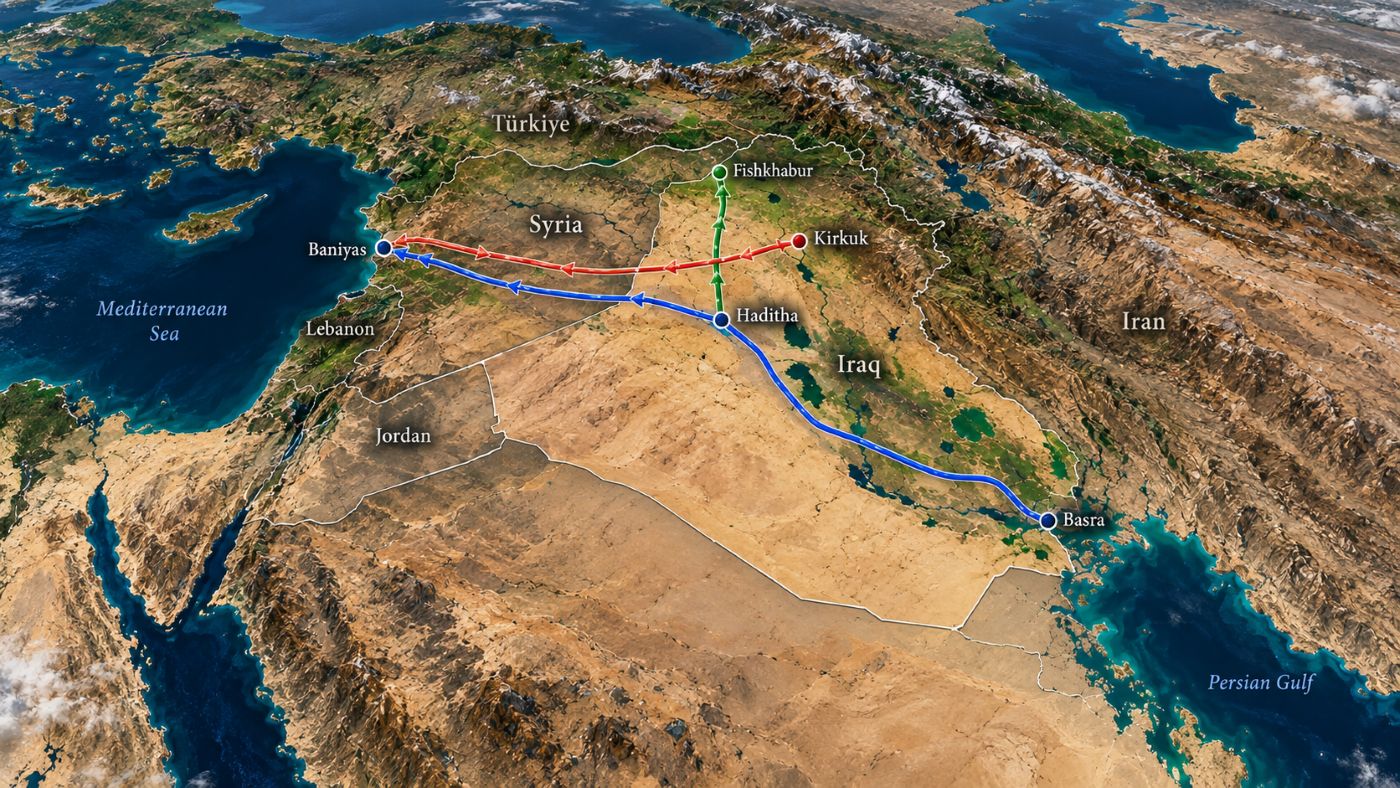
The proposed connectivity projects require a distinction among several different routes. The Iraqi-Syrian memorandum of understanding announced in July concerns the rehabilitation of the Haditha-Baniyas pipeline, while the broader discussion also includes reviving the historic Kirkuk-Baniyas route. Baghdad is also considering a future network extending from Basra to Haditha, with branches toward Syria and Türkiye. These different projects should not be treated as a single pipeline, nor should their planned capacities be considered current operational capacity. The Iraqi News Agency has reported Chevron’s role in the agreement concerning rehabilitation of the Haditha-Baniyas pipeline.
U.S. and international reporting also describes the broader route in terms of reviving the historic Kirkuk-Baniyas pipeline, which has remained largely out of service since sustaining damage after 2003. The Basra-Haditha project, by contrast, is a separate route still in the planning stage and could eventually serve as a connection feeding branches toward Baniyas or Türkiye, according to Reuters.
In early September, Baghdad began preparing feasibility studies, cost estimates, and route assessments for a proposed network with a total capacity of two million barrels per day from Basra to Haditha. From there, one planned branch with a capacity of one million barrels per day would extend toward Baniyas in Syria, while another branch of similar capacity would extend toward Fishkhabour and Türkiye. These figures represent planned capacities, not existing operational capacity, according to the Iraqi News Agency.
What Is Operating Today?
What is currently operational is the movement of Iraqi fuel oil by truck through Syrian territory to the port of Baniyas, which began during the spring of 2026, according to media reports and data cited by specialized energy-market sources. The fuel is stored at Baniyas and then loaded onto tankers for shipment to international markets. Reuters reported that Iraq began using the route after disruptions affected its exports through the Gulf.
In June, the Middle East Economic Survey (MEES), citing Kpler data, reported that Iraqi fuel-oil flows through this route were averaging approximately 140,000 barrels per day as of the date of the report.
A U.S. Inspector General report stated that Iraq’s state oil marketer, SOMO, had entered into agreements with four traders to transport approximately 650,000 metric tons of fuel oil per month to Syria by tanker truck, and that the first convoys entered Syrian territory on March 31.
The corridor demonstrates that Syria’s geography can be utilized for energy transit, but it also highlights its limitations. Operationally, transportation by truck is fundamentally different from a high-capacity pipeline. Trucking requires large numbers of journeys, border crossings, and loading and unloading facilities, while continuous pipelines can transport substantially larger volumes more consistently once completed.
Why Are Alternatives to Hormuz Becoming More Important?
The Strait of Hormuz crisis helps explain the growing importance of pursuing alternative routes. The U.S. Energy Information Administration reported that total flows of crude oil, condensates, and petroleum products through the strait averaged 21.6 million barrels per day in the fourth quarter of 2025 before falling to 4.9 million barrels per day in the second quarter of 2026 amid disruptions.
This is where the importance of the port of Baniyas on Syria’s Mediterranean coast becomes apparent. It could provide Iraqi oil exports with an overland route to the Mediterranean, bypassing the Gulf and the Strait of Hormuz. If the corridor develops into sustainable commercial activity, it could support port operations, storage, transportation, and logistics services while creating demand for the rehabilitation of Syrian infrastructure. Turning that potential into sustainable revenue for Syria, however, will depend on a clear legal framework, sustainable financing, security for transit routes and facilities, and long-term political and security stability.
The U.S. Dimension
For Washington, the objective is not to eliminate the importance of the Strait of Hormuz, but to reduce reliance on a single chokepoint. Barrack said in July that pipeline projects could help reduce dependence on the strait. The participation of Chevron in Iraqi energy agreements, alongside other U.S. companies, also gives the initiative an investment dimension in addition to its geopolitical significance, although final investment decisions will remain dependent on feasibility, financing, and security.
Policy Relevance
Syria does not currently represent a complete alternative to the Strait of Hormuz. However, the existing overland corridor and proposed pipeline projects could become part of a broader network for diversifying Iraqi energy export routes and reducing dependence on a single maritime chokepoint.
For congressional review, the key indicators will be the extent of actual progress in rehabilitating pipelines, securing financing, protecting transit routes and facilities, and moving projects from memoranda of understanding and feasibility studies into implementation, as well as the volume of oil that can ultimately be transported safely and sustainably through Syria to the Mediterranean.
The real measure in the years ahead, therefore, will not be the number of political statements, but the number of kilometers rehabilitated, the financing secured, the facilities constructed, and the volume of oil that can be transported safely and sustainably. Syria is not currently a complete alternative to the Strait of Hormuz, but it could become one component of a broader network of alternatives that provides Iraq and international markets with greater flexibility in the face of disruptions to maritime routes.
By Tony Bassmaji