

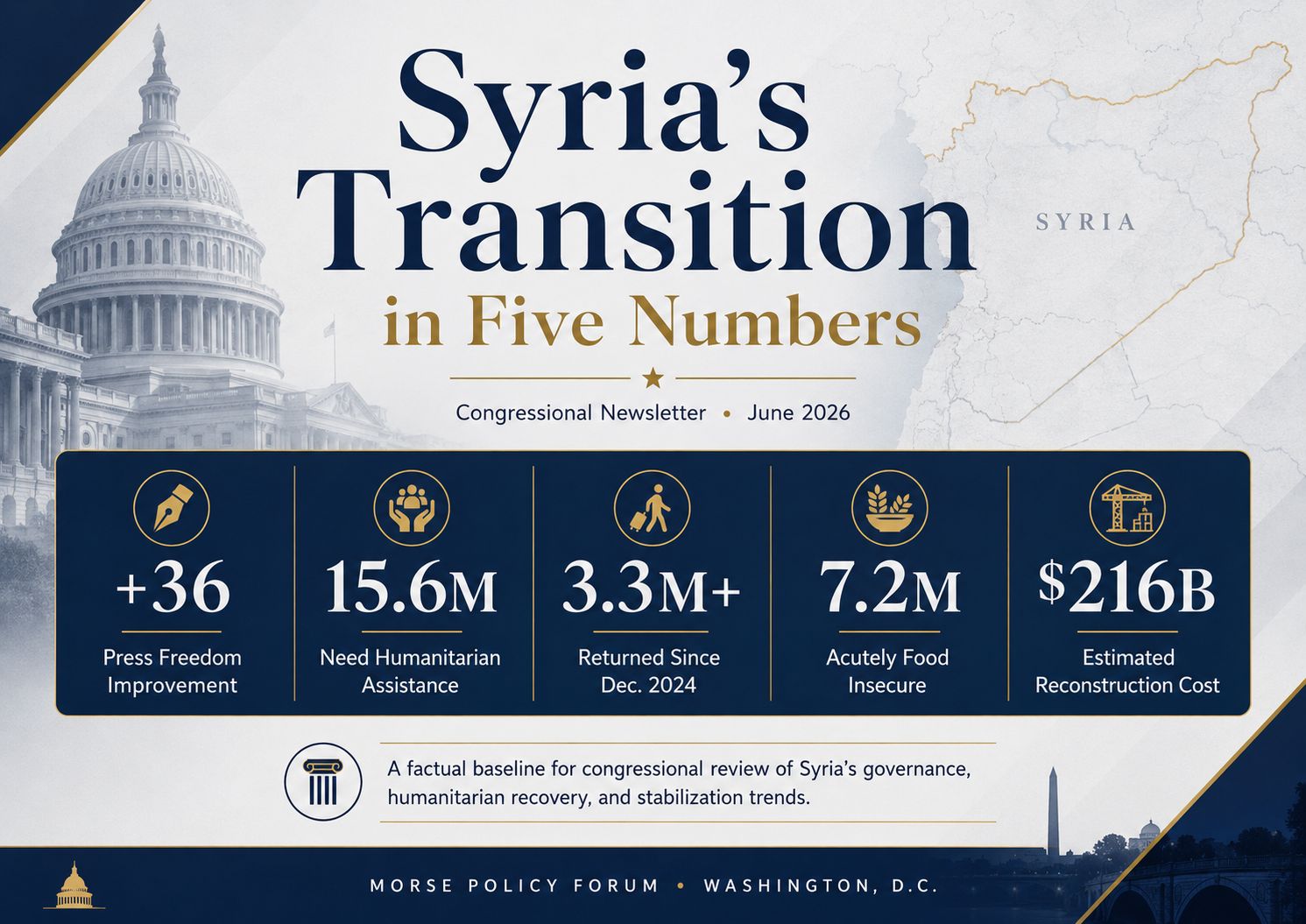
Five public data points show a mixed picture of Syria’s transition: measurable progress in press freedom and return movements, alongside major humanitarian, food-security, displacement, and reconstruction challenges. Together, these statistics provide a factual baseline for congressional review of Syria’s recovery, governance, and stabilization indicators.
Syria by the Numbers
+36
Press Freedom Ranking Improvement
Syria rose to 141st out of 180 countries in the 2026 RSF World Press Freedom Index.
15.6M
People Need Humanitarian Assistance
The 2026 Syria humanitarian plan targets 8.6 million people for assistance.
3.3M+
Syrians Returned Since December 2024
UNHCR reports over 1.5 million refugee returns and 1.8 million IDP returns.
7.2M
Acutely Food Insecure
WFP reports that more than 7 million people already face acute food insecurity.
$216B
Estimated Reconstruction Cost
The World Bank estimates Syria’s post-conflict reconstruction costs at $216 billion.
Syria’s transition is being measured not only through diplomacy and security developments, but also through public data on governance, humanitarian need, returns, food security, and reconstruction. These figures do not present a complete picture on their own, but they provide useful indicators for assessing both progress and continued fragility.
1. Press Freedom Improved by 36 Places
Number: Syria ranked 141st out of 180 countries in the 2026 World Press Freedom Index, up from 177th in 2025.
RSF described post-Assad Syria as the country with the largest improvement in the 2026 index, climbing 36 places after years near the bottom of the global ranking. This is a measurable public-space indicator after years of severe repression.
At the same time, Syria remains low in the global ranking. The improvement should therefore be read as an early signal of opening public space, not as proof of full press freedom.
2. 15.6 Million Syrians Need Humanitarian Assistance
Number: The 2026 Syria humanitarian plan lists 15.6 million people in need and 8.6 million people targeted for assistance.
Source: Humanitarian Action — Syria Humanitarian Needs and Response Plan 2026
The scale of humanitarian need remains high despite changes in Syria’s political and security environment. The gap between people in need and people targeted for assistance shows that humanitarian capacity remains limited and that prioritization is still necessary.
This figure is relevant to humanitarian access, stabilization planning, aid funding, and the ability of Syrian institutions and international partners to support vulnerable communities during transition.
3. More Than 3.3 Million Syrians Have Returned Since December 2024
Number: UNHCR reports over 1.5 million refugee returns and 1.8 million internally displaced person returns since December 2024, while 5.5 million Syrians remain internally displaced.
Return movements show a major shift in displacement patterns after the fall of the former regime. However, the continued presence of 5.5 million internally displaced people shows that return is still uneven and constrained by damaged housing, limited services, security concerns, and weak local absorption capacity.
Returns are relevant to humanitarian recovery, property restitution, local stability, reconstruction needs, and whether return conditions are becoming safe, voluntary, and sustainable.
4. 7.2 Million Syrians Are Acutely Food Insecure
Number: WFP reports that 7.2 million people in Syria are acutely food insecure.
Food insecurity remains one of the clearest indicators of household vulnerability. Even where security conditions improve, families continue to face high prices, damaged livelihoods, weak purchasing power, and limited access to basic services.
This figure is relevant to humanitarian funding, economic stabilization, agricultural recovery, sanctions compliance, and the risk that poverty and hunger could undermine local stability.
5. Syria’s Reconstruction Need Is Estimated at $216 Billion
Number: The World Bank estimates Syria’s post-conflict reconstruction costs at $216 billion.
Source: World Bank — Syria Physical Damage and Reconstruction Assessment
The World Bank’s estimate reflects the scale of physical damage after more than thirteen years of conflict. The assessment covers infrastructure, residential buildings, and non-residential assets, with the largest needs expected in heavily damaged governorates.
The reconstruction estimate is relevant to sanctions policy, development finance, private-sector engagement, anti-corruption safeguards, and the conditions under which international recovery support may become feasible.
Policy Relevance
Together, these indicators show a mixed picture: measurable progress in public space and return movements, alongside major humanitarian, food-security, displacement, and reconstruction challenges.
For congressional review, the value of these statistics is that they provide a factual baseline for assessing Syria’s transition over time. The figures point to areas of improvement, but also confirm that recovery remains fragile and dependent on security, governance, humanitarian access, legal safeguards, and institutional capacity.
Syria’s transition cannot be measured by a single indicator. The press freedom jump points to a possible opening in public space, while humanitarian need, food insecurity, displacement, and reconstruction costs show the scale of remaining pressure. Read together, the numbers show both movement and constraint: a country entering a new phase, but still facing deep structural challenges.
By Morse Policy Forum
SMNN Congressional Newsletter