
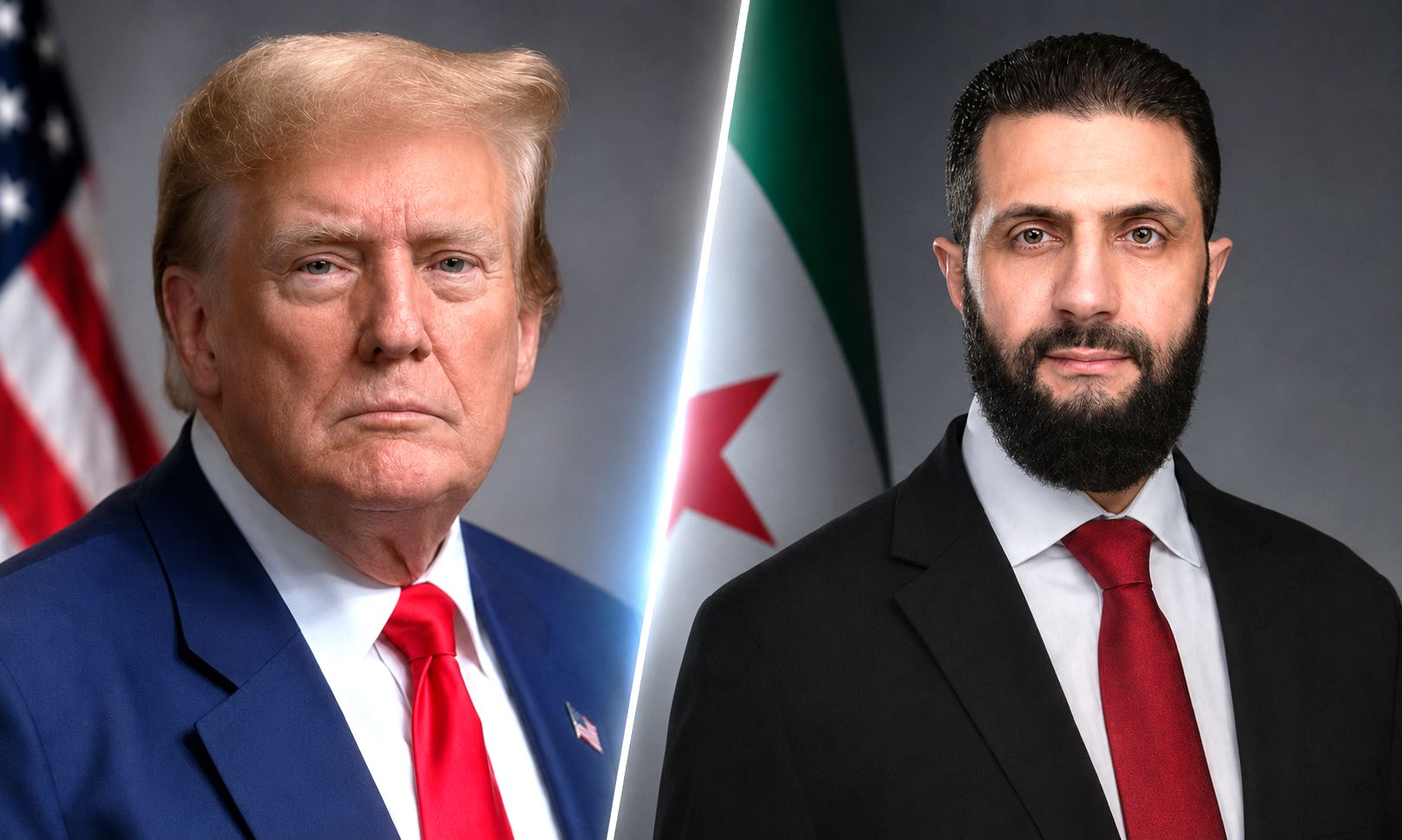
The Trump-Sharaa phone call reflects a gradual shift in U.S.-Syria communication, with growing discussion around sanctions relief, counter-ISIS coordination, border security, and Syria’s regional role. The policy relevance lies in whether this opening can develop into verifiable cooperation while preserving U.S. oversight, compliance, and accountability tools.
Reuters reported that Syrian President Ahmad al-Sharaa held a phone call with U.S. President Donald Trump, during which the two discussed support for Syria’s economy and the latest regional developments, according to a statement from the Syrian presidency. The call comes amid broader shifts in the relationship between Washington and Damascus, including significant sanctions relief, review of some U.S. designations, and growing discussion around security and economic cooperation.
The significance of the call does not lie only in the diplomatic contact itself, but in what it reflects: a gradual shift in U.S.-Syria channels of communication and the questions this shift raises about remaining sanctions, counter-ISIS cooperation, border security, Syria’s relationship with Iran, and the country’s potential role in regional stability.
Economic Recovery and Remaining Restrictions
According to Reuters and the Syrian presidency statement, the call focused on support for Syria’s economy and regional developments, with the Syrian side emphasizing that lifting remaining U.S. sanctions is necessary to revive the economy and attract investment. This comes amid growing Gulf interest in supporting recovery, infrastructure, and development projects.
At the same time, Washington maintains that dismantling most of the previous sanctions framework and repealing the Caesar Act does not mean that all restrictions have been removed. Targeted sanctions remain in place against Bashar al-Assad and his associates, human rights abusers, Captagon traffickers, entities linked to ISIS and al-Qaeda, and Iran and its proxies. As a result, the economic file remains tied to a careful balance between opening space for recovery and investment while preserving accountability and compliance tools.
Reordering Regional and Border Issues
On the security front, the discussions and related reporting extended to regional and border arrangements, particularly Syria’s role in controlling the Syrian-Lebanese border. Press reports indicate U.S. interest in the ability of Syria’s new leadership to limit weapons flows across the border and help reduce the influence of armed factions, in a way that supports the principle of arms being held by the Lebanese state.
This file is also connected to Washington’s broader calculations regarding Iranian influence in the region and Damascus’s ability to reshape its regional relationships within a gradual path toward international reintegration. In Damascus, political circles stress that engagement in these complex border files should be based on Syria’s national interest and sovereignty, while avoiding involvement in regional calculations that could affect internal stability.
Terrorism Designation Review and Field Coordination Challenges
On counterterrorism and field coordination, the two presidents reviewed ways to strengthen security stability and prevent renewed ISIS activity. The discussion came after Syria’s announced entry into the international coalition against ISIS at a political and coordination level, while noting that this does not necessarily mean Syrian participation in the coalition’s military mission known as Operation Inherent Resolve.
According to press reports, this development could open the door to new field and intelligence coordination mechanisms between Damascus and Washington. However, conditions in northeast Syria still reflect differences over the future approach to the Syrian Democratic Forces. The absence of comprehensive understandings among local actors could place counterterrorism efforts before complex coordination challenges that require gradual handling.
These diplomatic moves coincided with U.S. signals regarding a review of Syria’s designation as a State Sponsor of Terrorism, in addition to the appointment of a U.S. special envoy for the region. From the perspective of U.S. policy monitoring, these steps can be read as conditional diplomatic tools aimed at responding to changes in Damascus. Syrian state media, meanwhile, presents them as reflecting recognition of a new political reality and Damascus’s ability to open wider channels of communication with major international powers.
Policy Relevance
Despite this progress in direct diplomatic channels, the files under discussion between Washington and Damascus remain in a practical testing phase. Remaining sanctions, U.S. designation reviews, coordination in northeast Syria, and control of the Syrian-Lebanese border have all begun moving within a clearer negotiation and coordination track, but they have not yet reached final outcomes.
The significance of this track for congressional review lies in the way it reflects a gradual shift in U.S.-Syria relations, while leaving key questions unresolved: the conditions for lifting remaining restrictions, guarantees related to counter-ISIS efforts, border security, Syria’s relationship with Iran, and the nature of any long-term U.S. role in supporting regional stability.
In conclusion, the Trump-Sharaa call is a measurable indicator of renewed diplomatic movement between Washington and Damascus. It does not resolve the policy questions surrounding sanctions, terrorism designations, counter-ISIS coordination, or regional security, but it shows that these files are now being discussed through more direct channels.
For congressional review, the article’s significance lies in the balance between progress and conditionality: Syria is showing signs of a new diplomatic and security trajectory, while U.S. policy continues to preserve oversight, compliance, and accountability tools as the relationship develops.
By Lorees Omran
SMNN Reporter – Lattakia, Syria